
A recent Windows security update is under scrutiny after users reported noticeable performance drops on Nvidia graphics cards. The update, KB5074109, was included in Microsoft’s January 2026 Patch Tuesday release.
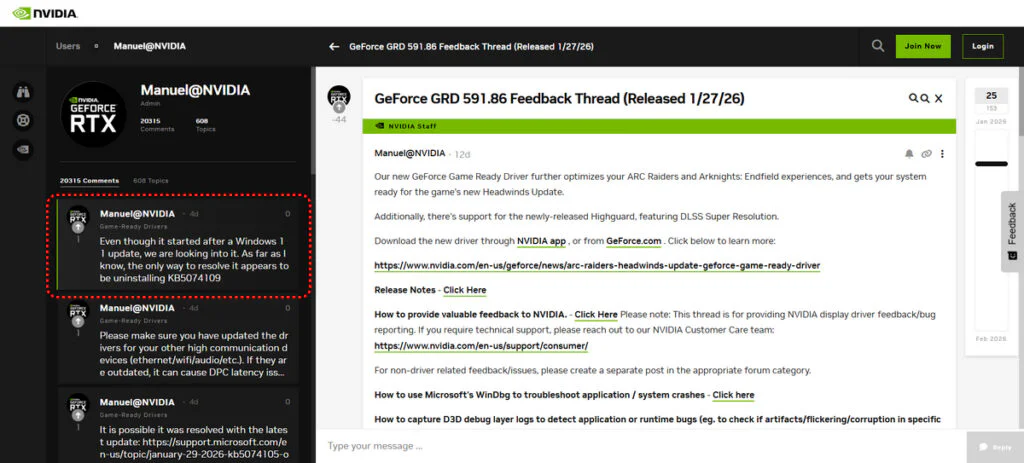
Users began reporting several graphical issues in January, including 15-20 FPS performance losses, screen flickering, shadow artifacts, and frame generation problems. While Nvidia’s January driver updates were initially suspected, an administrator on Nvidia’s official forums later recommended uninstalling Windows update KB5074109 and said the issue is under joint investigation with Microsoft.
Microsoft has not issued a public response to the recent GPU-related reports. Users can check whether the update is installed by going to Settings > Windows Update > Update history, where an uninstall option is listed near the bottom.
The January update was a large, mandatory release that bundled more than 100 security fixes, making it likely that most up-to-date Windows 11 systems installed it. Its rollout, however, has been plagued by a series of serious issues, including broken Remote Desktop connections to Azure and Microsoft 365, reboot loops on certain secured devices, Outlook launch failures, and various visual glitches. Microsoft later issued several out-of-band patches to address some of the problems, though others remain unresolved.
Microsoft is expected to roll additional fixes into February’s cumulative update, with some optional patches already available via the Microsoft Update Catalog. It remains uncertain whether those updates will fully resolve performance issues affecting Nvidia GPUs. AMD graphics card users, by contrast, have not reported similar problems at scale.
The incident follows a series of Windows updates that have caused issues with connectivity, Blu-ray playback, and system recovery tools in recent months. The repeated instability has reportedly led Microsoft engineers to prioritize performance and system stability over adding new features.
Many users have linked the decline in update reliability to Microsoft’s increasingly aggressive use of generative AI in its development workflow. While there is no direct evidence tying AI-assisted coding to the specific flaws in KB5074109, the most severe run of issues followed public disclosures about the scale of AI’s involvement. CEO Satya Nadella said last year that AI now produces up to 30 percent of Microsoft’s code, while CTO Kevin Scott suggested that so-called “vibe coding” could dominate software development by 2030.
Maybe you would like other interesting articles?