

What if everyday fabrics could double as audio devices? Sensia, a Japanese startup, is making that idea a reality with a fabric speaker that can be woven into tapestries or blankets. Built on years of government-funded research, the product marks the first commercial deployment of sound-emitting textiles.
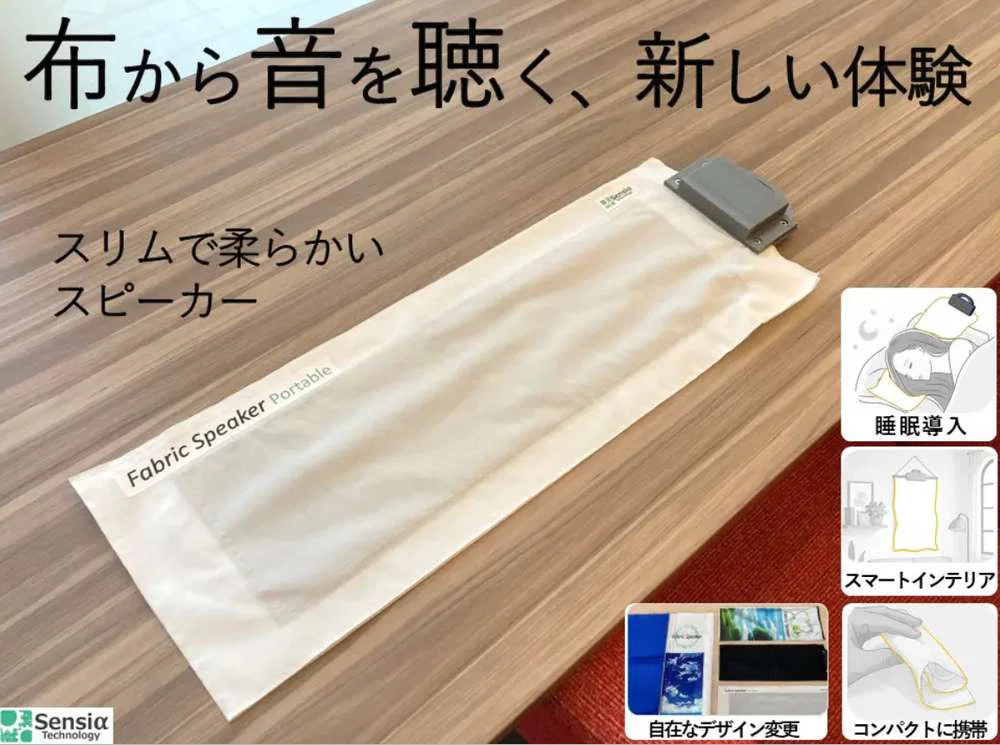
The technology was first developed in 2018 at Japan’s National Institute of Advanced Industrial Science and Technology (AIST), where researchers created a thin, lightweight, and flexible electronic textile. Sensia’s Fabric Speaker Portable takes that experimental work into a consumer setting, translating it into a home-ready product that does away with conventional speaker components and bulky enclosures.
How Can Fabric Make Sound?
Sensia’s solution revives electrostatic speaker architecture using textile-friendly materials. The fabric operates as a flexible capacitor, combining two conductive layers with an ultra-thin dielectric in between. Audio signals modulate the electric field, setting the fabric into motion and evenly radiating sound across the full area of the textile.
Unlike earlier textile audio products that embed standard rigid drivers inside fabric housings, Sensia’s system produces sound across the entire material. Traditional designs often suffer from uneven sound distribution and physical bulk. By radiating audio uniformly, Sensia’s fabric eliminates dead zones and maintains a slim, pliable form factor.
The supporting electronics are housed in a slim plastic module mounted along the edge of the textile, providing power, Bluetooth connectivity, and the necessary drive circuitry. Sensia lists a maximum output of approximately 68 dB for a single unit, increasing to around 71 dB when paired. In practical terms, that places it in the range of ambient household noise, adequate for casual listening, but not high-output playback.
The company has not released detailed information on frequency range or distortion, signaling that the speaker is designed primarily for personal and ambient use. Suggested applications include hanging it as a sound tapestry, placing it beneath a bedsheet for subtle wake-up audio, or integrating it into furniture cushions for a discreet, immersive effect.
Sensia’s fabric speaker is still niche, but it points to how flexible microelectronics could reshape audio hardware. By abandoning the box-and-driver model, it hints at a future where sound is woven into cars, curtains, clothing, and smart-home fabrics instead of enclosed in plastic and metal.
The fabric speaker is unlikely to replace a high-fidelity audio system anytime soon. Still, it offers a telling glimpse of a future in which technology fades into the background, blending seamlessly with the spaces we inhabit.
Maybe you would like other interesting articles?