
Documents revealed during federal antitrust proceedings show that Google has set a timeline to wind down ChromeOS, the cloud-centric operating system used on Chromebooks. Court transcripts indicate the platform is scheduled to be fully retired by 2034.
The filings, submitted in the case that concluded Google illegally monopolized web search, lay out the timeline yet for ChromeOS’s future. They show Google must continue supporting existing devices through at least 2033, in line with its 10-year update pledge to consumers and schools, with a full wind-down expected in 2034.
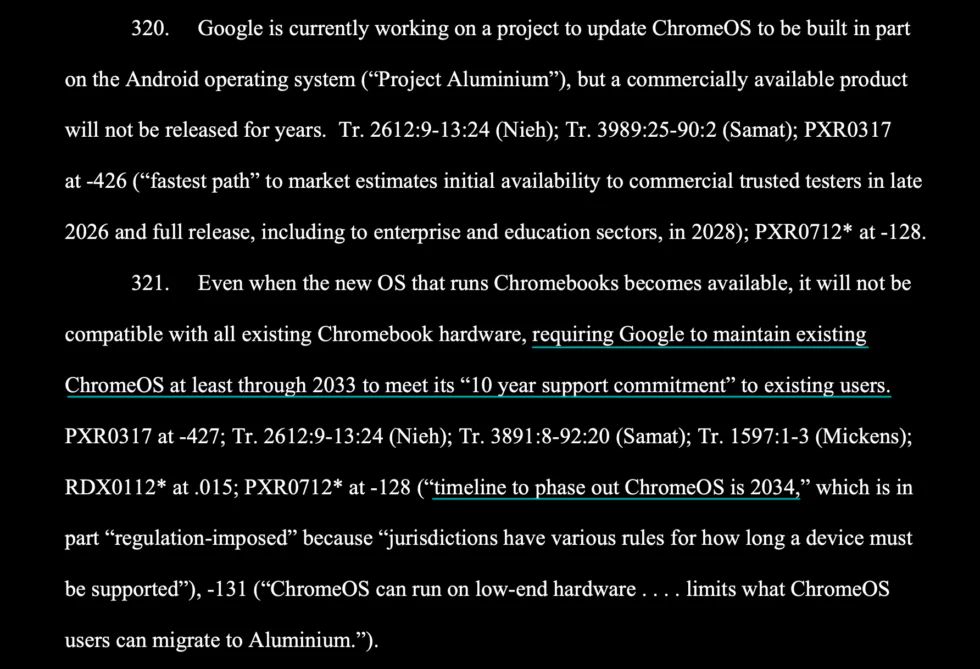
The planned retirement aligns with Google’s stated goal of consolidating its operating systems. In 2025, the company announced plans to fuse Android and ChromeOS into a single desktop platform, internally referred to as “Aluminium OS.” Court records now make clear that this project is intended to succeed ChromeOS on future devices.
Although Google lost its case against the U.S. Department of Justice and is now addressing the ruling’s fallout, it retained control of the Chrome browser. Court transcripts clarify that ChromeOS and any future platforms are treated separately. The court also acknowledged that ChromeOS and its successors are complex systems built on top of Chrome and Linux, with Chrome’s rendering engine expected to remain central to the forthcoming Aluminium OS.
Based on details disclosed during the proceedings, Aluminium OS is expected to be a desktop-focused variant of Android, designed to run on both ARM and x86 processors. It would support Android and ChromeOS applications, either natively or with minimal compatibility adjustments for larger displays.
The disclosure sheds new light on Google’s long-term hardware strategy. If Aluminium OS operates as described in court, it could serve as a unified platform for low-cost educational devices and desktop systems, with a gradual transition away from ChromeOS over the coming years.
For millions of Chromebook users, particularly in education, the 2034 timeline sets a clear support horizon. Google now faces the challenge of overseeing a decade-long shift away from the operating system that defined its move into personal computing.
Maybe you would like other interesting articles?