
France’s National Assembly has passed legislation aimed at limiting young people’s exposure to digital platforms, approving a ban on social media for children under 15 and restricting mobile phone use in high schools. The late-Monday vote places France alongside countries like Australia that have recently moved to tighten online protections for minors.
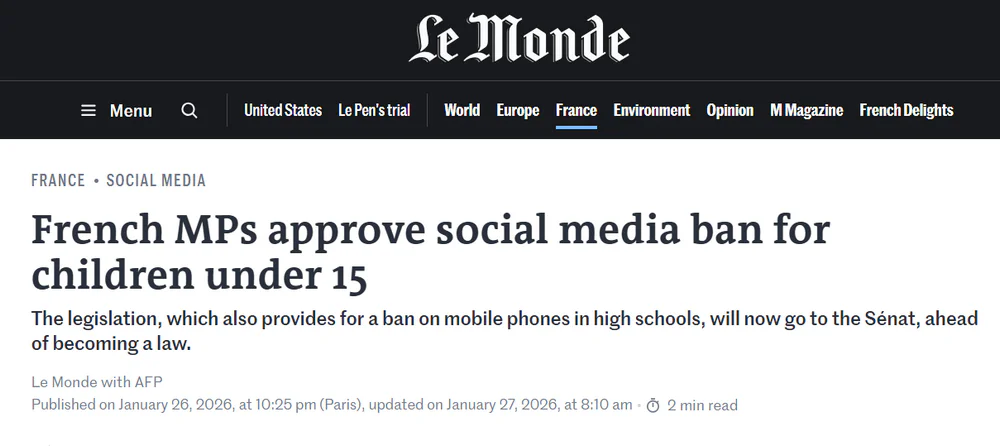
The legislation passed the lower house of the French Parliament by a decisive 130-21 vote, drawing support from both sides of the aisle. Lawmakers pointed to concerns over cyberbullying and harmful online content as key reasons for the proposal.
The legislation will now move to the French Senate for consideration, after which it will require the signature of President Emmanuel Macron. Macron welcomed the vote, describing it as a “major step” toward protecting children’s safety and mental well-being.
In a televised address, President Emmanuel Macron pressed the Senate to move swiftly, casting the issue as one of national sovereignty and child protection. He warned against the influence of foreign technology firms, saying children’s emotions “are not for sale or to be manipulated,” and cited scientific advice and strong public backing for tighter limits on screen time.
If approved, the law could come into force at the start of the next school year in September. The vote is being closely followed across Europe, as countries including Germany, Denmark, Spain, and Italy weigh similar limits on children’s use of social media.
France’s move follows similar action in Australia, which last month became the first democracy to enforce a mandatory minimum age of 16 for social media use. The Australian law applies to major platforms, including Facebook, Instagram, TikTok, Snapchat, X, and YouTube, and led to the removal or deactivation of at least 4.7 million suspected underage accounts within days of taking effect. Companies that fail to comply face fines of up to A$50 million, or about $32 million.
The French Senate’s upcoming debates will decide whether France joins Australia in leading efforts to restrict minors’ digital access.
Maybe you would like other interesting articles?