

While many users are anticipating the eventual end of the AI hype cycle, manufacturers are struggling with tougher constraints. The traditional supply chain has largely disappeared, and consumers may ultimately bear the cost, starting with mainstream laptops.
According to a new analysis by TrendForce, the outlook for mainstream laptops may be worsening. The firm projects that notebook prices could increase by up to 40%, as ongoing CPU manufacturing constraints compound instability in the memory chip sector.
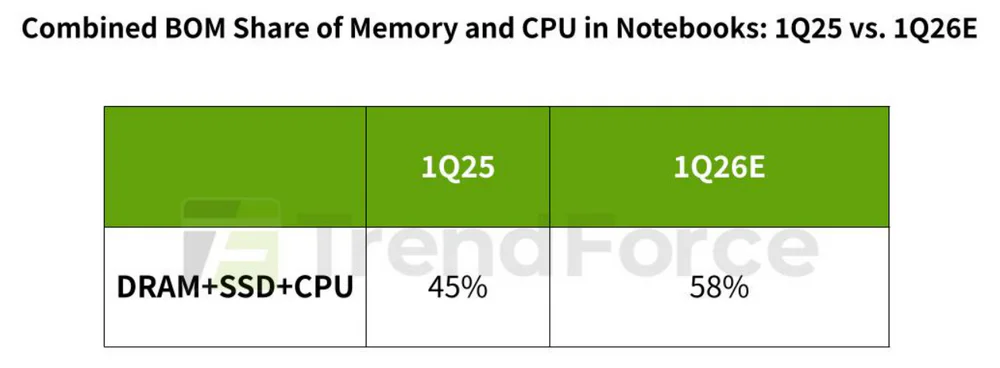
TrendForce classifies a mainstream notebook as a system with a suggested retail price near $900. Its baseline model assumes that price point for laptops shipped in the first quarter of 2025. Before the AI-driven demand spike, memory components, primarily DRAM and SSD storage, represented about 15% of the total bill of materials for a typical notebook.
Just one year on, memory is forecast to represent more than 30% of a notebook’s total bill of materials. Should chipmakers and OEMs attempt to preserve existing margins, the $900 mainstream laptop of 2025 could carry a price roughly 30% higher.
The growing cost impact of memory components was recently highlighted by HP Inc., which noted that RAM alone now represents roughly 35% of the cost of building a new PC/Laptop. As one of the world’s largest OEMs, the company says it intends to safeguard its margins through a predefined optimization strategy. Ultimately, however, some of the strain on the supply chain is likely to reach consumers.
But the situation may get even worse.
Data from TrendForce indicates that Intel has lifted pricing on certain legacy entry-level processors by more than 15%. The chipmaker is also expected to roll out price increases for midrange and high-end computing platforms during the second quarter. With CPUs already among the most expensive components in a notebook’s BOM, OEMs may be compelled to adjust retail pricing upward.
Still, pricing pressure is not only tied to component costs, it is also linked to supply. TrendForce points to growing strain in CPU manufacturing for companies such as Intel and AMD. The broader supply chain is becoming less stable as many companies prioritize partnerships with Nvidia and investments in large-scale AI data centers, drawing resources away from the conventional PC/Laptop market.
TrendForce estimates that if memory and CPU costs rise in parallel, retail prices for mainstream notebooks could increase by up to 40%. The broader question is whether CPU vendors will ride the same wave of demand currently boosting memory suppliers, while higher system prices potentially sideline many PC/Laptop enthusiasts.
Maybe you would like other interesting articles?