
Several leading PC hardware companies are supporting a new Microsoft initiative focused on addressing shader compilation stutter, a long-standing frustration for PC gamers.
During the Game Developers Conference (GDC) this week, Nvidia announced its official support for Microsoft’s Advanced Shader Delivery (ASD) technology, confirming the feature will arrive on RTX graphics cards later this year. AMD has also confirmed it will support the standard, though the company has yet to release specific implementation details.
The collaboration, which includes Intel and Qualcomm, targets a technical bottleneck that has plagued even high-end systems for years.
Shader compilation stutter occurs when a game suddenly hitches or drops frames, not because the hardware is too weak, but because the GPU is busy translating graphics instructions on the fly.
When developers build video games, they rely on shaders, small programs that handle lighting, shadows, and textures. Before they can run, those shaders must be translated into instructions the specific graphics chip can understand.
For console games, this is a solved problem. Because the PlayStation, Xbox, and Switch have fixed, identical hardware configurations, developers can pre-compile every shader needed for the game before it ever reaches the user.
The PC, however, presents a “near-infinite variety” of hardware configurations. Since developers can’t possibly pre-compile shaders for every combination of CPU, GPU, and driver version, the task is often left to the end user.
Some modern games have attempted to mitigate this by compiling shaders during an initial loading screen, forcing players to wait several minutes before playing. However, these lengthy startup processes often have to be repeated whenever a user installs new graphics drivers.
How Microsoft’s Solution Works
Microsoft aims to solve this by changing how shaders are cataloged, stored, and distributed to PCs.
The new framework relies on two core components: the State Object Database (SODB) , which introduces a new format for storing shaders, and the Precompiled Shader Database (PSDB) .
The process utilizes Intel’s offline compiler to pre-build the shaders. When a user installs a game or updates their graphics drivers, the Xbox app automatically downloads the correct, pre-compiled shaders from the PSDB, theoretically eliminating the need for on-device compilation and its associated hitching.
While ASD is new to the broader PC ecosystem, it has already been battle-tested. The technology debuted last year on the Asus ROG Ally and Ally X handhelds. According to Microsoft, the feature reduced initial load times in the RPG Avowed by 80 percent.
At GDC, Microsoft announced an SDK update that will allow developers to begin testing ASD on other Windows 11 devices, paving the way for wider adoption.
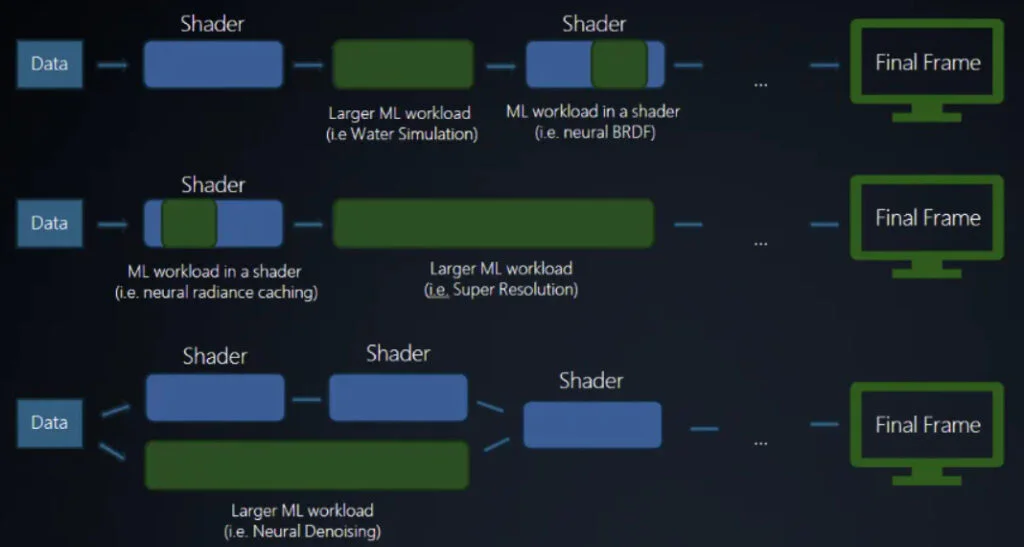
Microsoft said it is working closely with Nvidia, AMD, Intel, and Qualcomm to bring machine learning workloads directly into DirectX, with the goal of standardizing how features such as upscaling, denoising, and texture compression operate across different hardware platforms.
Additionally, Intel, AMD, and Microsoft announced an update to the DirectStorage API. The update introduces support for Zstandard compression, a move designed to help developers further reduce load times on SSDs. To assist developers in optimizing these processes, Microsoft’s PIX debugging and performance tuning tool will also receive updates to streamline the debugging workflow.
Maybe you would like other interesting articles?