

A year after unveiling one of the biggest shake-ups to its app ecosystem in recent memory, Google now appears to be treading carefully, maintaining Android’s open roots while introducing new guardrails that make it harder for everyday users to stray beyond them.
The company has confirmed that sideloading will remain part of the platform, but a newly introduced process intentionally makes it harder to complete. Google refers to the system as an “advanced flow,” and acknowledges that it expects only experienced users to follow it to the end.
The compromise traces back to 2025, when Google announced plans to require developers to verify their identities with government-issued ID before distributing apps to Android users. The move sparked immediate pushback from third-party developers and alternative marketplaces, particularly the open-source repository F-Droid. The reaction was strong enough for Google to abandon the requirement, with the later “advanced flow” emerging partly as a response to concerns raised by that community.
“Android is built on choice. That is why we’ve developed the advanced flow – an approach that allows power users to maintain the ability to sideload apps from unverified developers,” Matthew Forsythe wrote in a post on the Android Developers Blog.
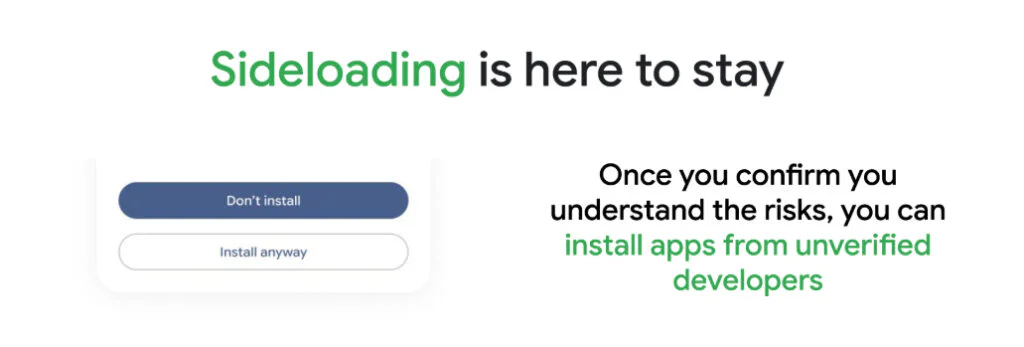
Forsythe framed the system as a safeguard against coercion, scams, and malicious apps. The process is completed once and unfolds across four separate stages, each intended to confirm the user is proceeding knowingly and by choice.
The process begins by enabling developer mode in Android’s settings. Users must then confirm they are not being instructed to bypass the platform’s protections. The device is restarted, which starts a 24-hour waiting period. After that, a final confirmation allows sideloading to be enabled for seven days or indefinitely. The system continues to show warnings, though it ultimately permits the installation.
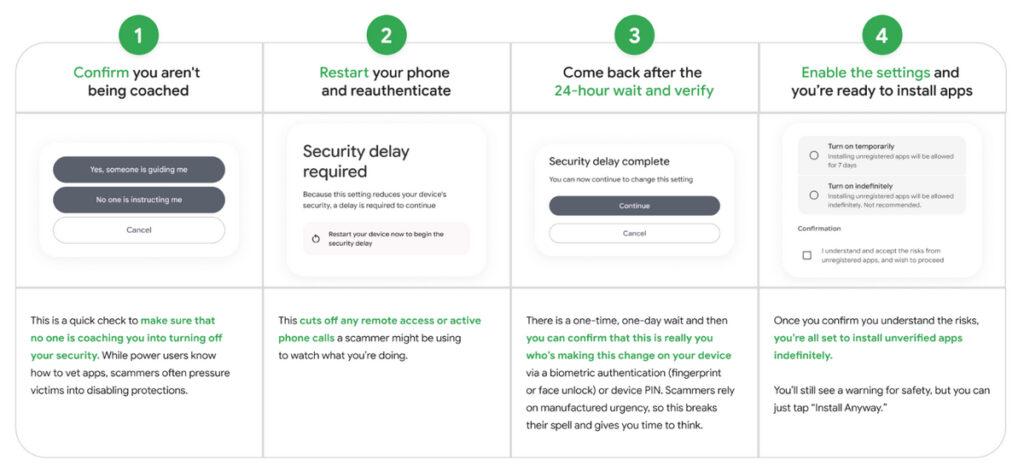
The advanced flow is limited to apps from unverified developers. Software from newly registered developers, who comply with the ID requirement, uses a different and less demanding installation path.
Forsythe acknowledged that mandatory developer identification could create a real barrier for newcomers to the Android ecosystem, but maintained that the advanced flow keeps the platform open for users who still want that flexibility. The new process is expected to roll out in August, while the broader ID-based developer registration system is slated for global deployment in 2027.
For the majority of Android users, little will change. The advanced flow is intentionally limited, available mainly to those who know about it and are willing to complete the process.
Maybe you would like other interesting articles?