

Intel used its Core Ultra 3 Series announcement at CES 2026 to spotlight a mobile GPU claim, asserting that the Arc B390 iGPU in Panther Lake processors surpasses AMD’s Radeon 890M in the low-power segment.
Intel also confirmed plans to build a handheld gaming platform with multiple partners, challenging AMD’s dominance in the space.
According to Intel’s benchmark slide, which averages results from 45 games, the Arc B390 was tested at a 45W system power draw, while the competing AMD setup ran at 53W. Both systems used 1080p output upscaled from 540p, a scenario in which Intel says it holds a clear performance lead.
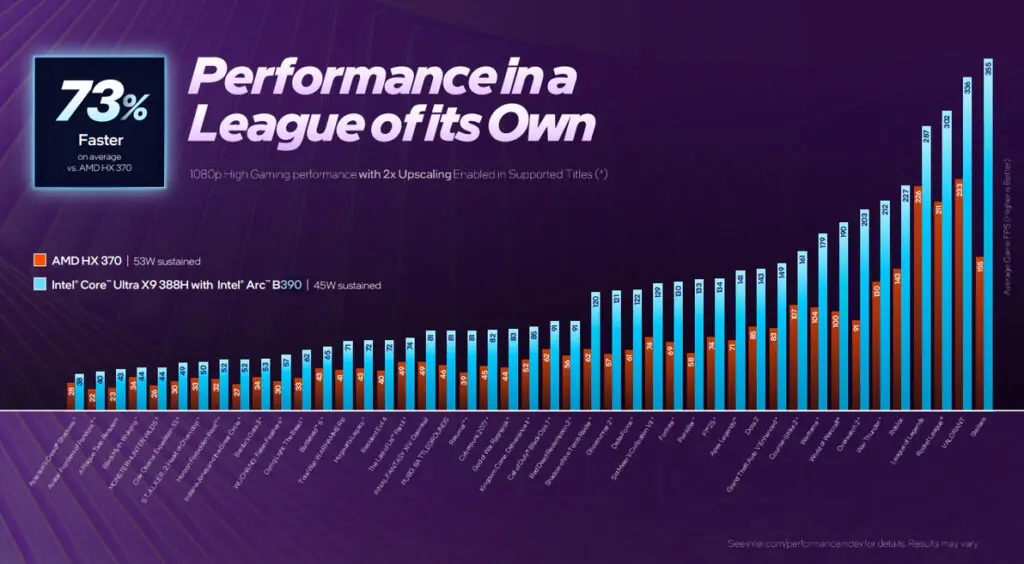
Performance results vary widely, with demanding games such as Assassin’s Creed Shadows and Black Myth: Wukong running in the 30-40 fps range, while lighter esports titles like League of Legends and Rocket League reportedly approach 300 fps without frame generation. Intel says the average performance advantage increases to 82% when tested at native 1080p without upscaling.
Intel also highlighted its XeSS upscaling technology, claiming the current version already outperforms AMD’s FSR3 on the Radeon 890M. The company added that the upcoming XeSS 3 will introduce multi-frame generation to mobile hardware for the first time.
XeSS 3 works in a similar way to Nvidia’s DLSS 4 on RTX 50-series desktop cards, using AI to slot in as many as three extra frames between rendered ones to make gameplay feel smoother. Intel showed benchmarks that put it ahead of FSR and DLSS, though it didn’t address how much added input latency comes with the approach.
Experts say multi-frame generation delivers the most noticeable gains on displays with refresh rates of 240Hz or higher.
Intel’s Arc B390 uses the new Xe3 Arc Battlemage architecture with 12 Xe cores, and it’s being pitched as a rival to AMD’s Radeon 890M, the chip behind handhelds like the ROG Ally X and MSI Claw A8.
AMD also made announcements at CES, introducing the Ryzen AI 400 series. The new mobile processors continue to use RDNA 3.5-based integrated graphics from the previous Ryzen AI 300 lineup. AMD additionally previewed its upcoming Strix Halo APUs, referred to as large-scale APUs, which are expected to deliver PlayStation 5-class performance. At present, the only announced handheld using the chip, the GPD Win 5, is priced at nearly $2,000.
The benchmarks may have centered on 45W laptops, but Intel’s larger intentions were on full display. A slide listing partners, including Microsoft, MSI, Acer, GPD, and OneXPlayer, pointed to a coordinated move into handheld PCs. One absence was hard to ignore: Asus, AMD’s key ally behind the ROG Ally lineup.
It remains unclear how the Arc B390 will perform at the 15-30W power levels typical of handheld devices, an area where AMD currently leads. Intel’s presentation indicates the company is now focused on addressing that challenge.
Maybe you would like other interesting articles?