
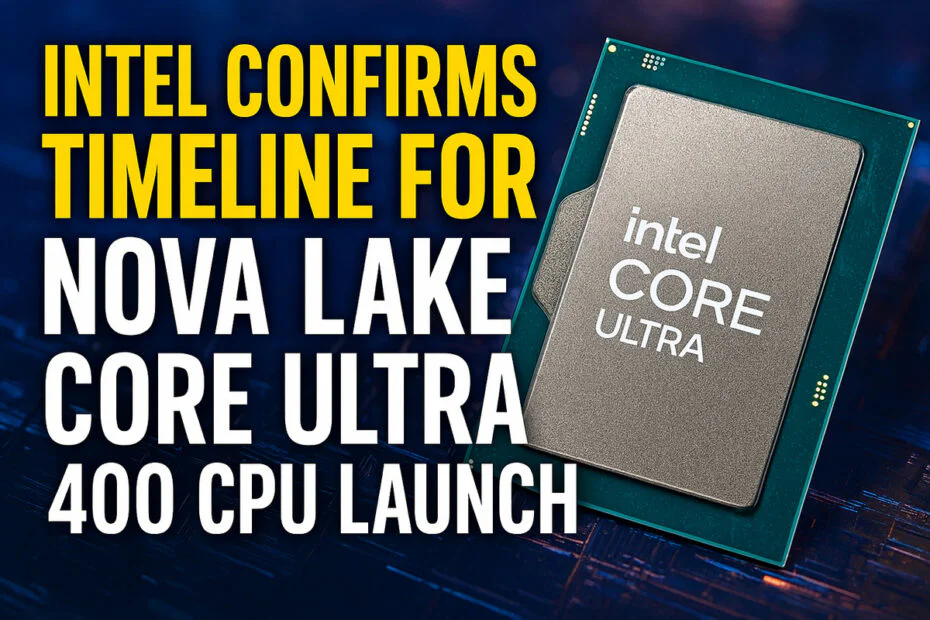
Intel has confirmed plans for its next-generation Nova Lake desktop processors, expected to debut as the Core Ultra 400 series in late 2026. The update came during Intel’s fourth-quarter 2025 earnings call, where CEO Lip-Bu Tan said the new lineup remains on schedule for release later this year.

The announcement highlights Intel’s renewed effort to regain ground in the high-performance desktop market. Over the past several years, the company has steadily lost share across both desktop and laptop segments, pressured by AMD’s Zen-based processors and Apple’s in-house silicon. During the call, Tan emphasized Intel’s goal of rebuilding its desktop and notebook presence in the years ahead.
Industry watchers often highlight AMD’s 3D V-Cache technology as a key competitive factor. The added L3 cache up to 128MB on Ryzen X3D processors has translated into strong gaming performance, an important metric in the enthusiast market. Intel’s Raptor Lake and Arrow Lake generations have struggled to displace those cache-heavy parts, making the expected Nova Lake versus Zen 6 matchup later this year a potentially defining moment.
Leaked details from trusted industry sources indicate that Nova Lake could represent Intel’s most aggressive desktop redesign in years. The rumored Core Ultra 9 485K is expected to feature a 52-core hybrid configuration combining 16 Coyote Cove P-cores, 32 Arctic Wolf E-cores, and four low-power island cores, alongside Xe3 “Celestial” integrated graphics and a 150W TDP. Lower-tier Core Ultra 7 and Core Ultra 5 SKUs are believed to top out at roughly 42 and 28 cores, respectively.
Cache is shaping up to be one of the biggest flashpoints in the next CPU fight. Right now, Intel’s Arrow Lake caps out at 36MB, while AMD’s Zen 5 X3D stretches to 128MB. That’s expected to change fast. Nova Lake is rumored to lean on a large last-level cache approach borrowed from Intel’s Clearwater Forest server chips, and in top-end setups, total cache could reportedly balloon to an eye-catching 288MB.
The platform shift will also require new motherboards, with Nova Lake moving to the LGA 1954 socket alongside Intel’s 900-series chipset. The update is expected to introduce modern connectivity features, including native DDR5 support at speeds up to 8,000 MT/s with headroom for 10,000 MT/s, along with 48 PCIe lanes, 24 of which support PCIe 5.0, plus expanded USB and SATA options.
Even after rolling out its new 18A process with Panther Lake on the mobile side, Intel isn’t expected to use it for Nova Lake desktops. Instead, those chips are widely believed to be built on TSMC’s 2nm N2 process.
With development officially confirmed and a late-2026 launch target, Nova Lake is poised to become a key battleground in the desktop CPU market as Intel looks to challenge AMD’s long-standing lead in gaming performance.
Maybe you would like other interesting articles?