
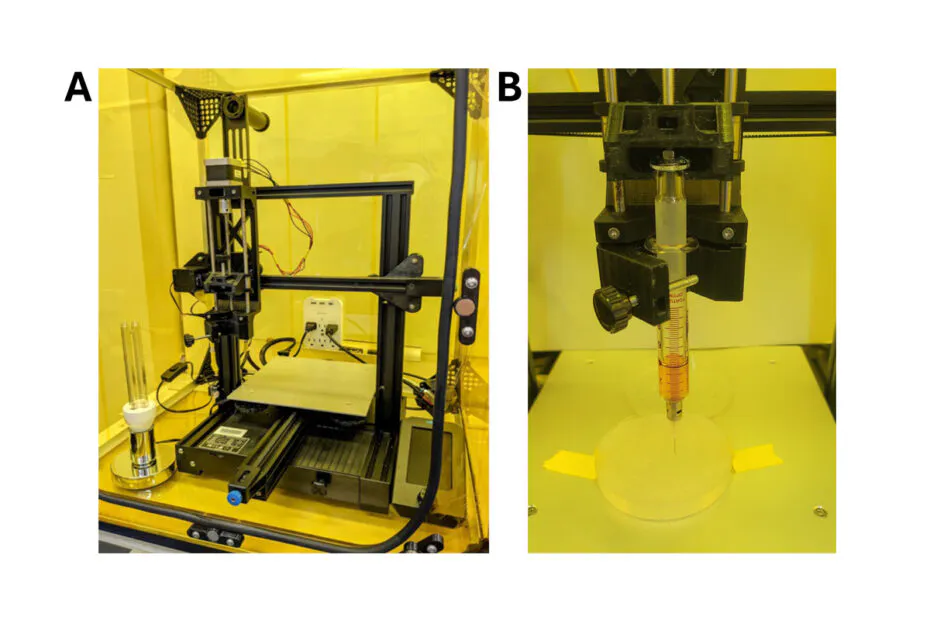
A bioprinter is essentially a 3D printer that deposits gel containing living cells instead of molten plastic. Commercial models can cost over $100,000, which has led some laboratories to adapt inexpensive hobbyist printers. However, the gel is soft and sags before it solidifies, so most of these homemade machines can print only fewer than 20 layers.
Well, a team from Rochester and Cornell just built one that can stack around 100 layers, and the whole thing cost about $450. They write in ACS Applied Polymer Materials that they took a regular Creality Ender 3, pulled off the print head, and bolted on a syringe pump made from 3D-printed PETG pieces.
The pump can both push ink out and pull it back between movements, similar to the retraction setting Ender users adjust to prevent stringing. Fine-tuning these movements reduced stray bacterial deposits by nearly 100-fold. According to lead researcher Anne Meyer, this allows the system to print “crisp shapes with well-defined edges.”
The additional height is possible because of where the ink is deposited. The nozzle works inside a slurry of small gelatin or agarose particles mixed with calcium chloride, rather than on a bare build plate. The slurry supports each layer as it is printed, and the calcium rapidly sets the alginate-based ink. Carnegie Mellon’s FRESH method uses essentially the same technique to print human liver tissue.
The preprint reports a 100-layer print height of just under 22 mm, about the diameter of a US nickel. That’s sufficient for hollow cylinders and lattices, geometries that matter here. According to Meyer, the added surface area improves nutrient uptake and byproduct release for the encapsulated bacteria.
The two baths had different jobs. Gelatin let the researchers lift a finished printout whole. Agarose stayed put and became a home for the bacteria. That mattered, because printed bacteria used to start dying after about nine days. In the agarose, fed by nutrients mixed into the bath, the team’s E. coli lived for four weeks.
Meyer’s lab has spent more than a decade building its own bioprinters to make living test structures for antibacterial research and wastewater treatment. She says the longer incubation window could let researchers grow engineered biofilms, the slimy bacterial colonies that cling to surfaces, that look more like the ones found in medical settings. Depending on which bacteria they carry, such prints might also help purify contaminated water or break down plastic.
The researchers didn’t keep the design to themselves. They uploaded the STL files and G-code to GitHub for anyone to use. And since it all starts with an ordinary Ender 3, many labs and hobbyists are probably halfway there already.
Maybe you would like other interesting articles?