
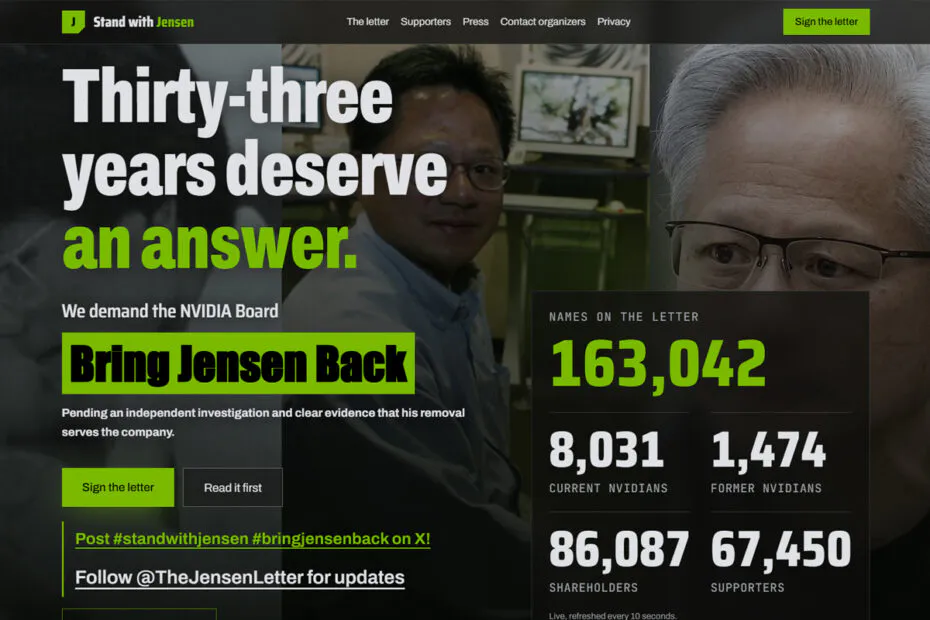
Jensen Huang has been out as Nvidia’s CEO for three days, and a push to reinstate him is growing fast. An open letter asking the board to bring back the company’s co-founder, at least until an independent investigation concludes, has passed 150,000 signatures. Elon Musk and Epic Games CEO Tim Sweeney have publicly backed it, as have thousands of signers who say they work for or hold shares in Nvidia.
The campaign is called Stand with Jensen. It follows a hard week for the world’s largest chipmaker. Nvidia lost its only CEO, the stock fell, and the board is searching for a successor. New questions have also emerged about how Huang built and financed the AI boom.
The people behind the letter say Huang was forced out without ever getting a fair shot at defending himself. They’re asking the board for three things: put him back in the CEO seat while the investigation is still ongoing, give him a proper hearing, and explain in public why he was let go.
Support for the petition has spread across Silicon Valley. Besides Musk and Sweeney, the signers include Replit CEO Amjad Masad and Y Combinator CEO Garry Tan.
Per the campaign, thousands of signers had listed themselves as current Nvidia staff by Sunday, with tens of thousands more claiming to be shareholders. Those figures are self-reported and unverified, the organizers note, and they stress that neither Nvidia nor Huang is behind the effort.
Board sentiment at Nvidia appeared to shift quickly last week. That is part of why the petition matters.
Nvidia’s board initially stood by its CEO. On November 8, after Huang admitted to an affair with Alice Huang, a businesswoman US intelligence officials suspect of working for China, directors voiced public confidence in him and commissioned an independent probe into possible exposure of national security or trade secrets. The espionage allegations against Alice Huang, no relation to Jensen, remain unproven.
Things moved quickly after that. A shareholder lawsuit against Nvidia and Huang alleged that investors had been misled about the relationship. On Wednesday, reports surfaced of a second affair, this one involving Kimberly Powell, Nvidia’s VP of health care, at the same time as word that directors were preparing to remove Huang.
Huang left Nvidia by Thursday morning, after 33 years at the company he co-founded in 1993. Nvidia announced his resignation as CEO, president, and board member. It did not give a reason.
Nvidia has installed CFO Colette Kress as interim CEO and made longtime director Harvey Jones its first-ever board chair. The permanent search faces a steep bar: very few executives pair Huang’s engineering depth with his standing among the largest tech companies and his influence over the AI buildout.
Nvidia’s board says nothing has changed in its succession planning. The first real checkpoint is the quarterly earnings report, due as early as Tuesday. The numbers reflect Huang’s last full stretch at the helm, but Kress will be the executive on the call taking investor questions about where the company goes from here.
Maybe you would like other interesting articles?