
The world’s largest PC gaming platform, Steam, is facing challenges around game visibility. According to recent data, close to half of the roughly 19,000 titles released in the last year attracted little to no audience, revealing a growing imbalance between release volume and player engagement.
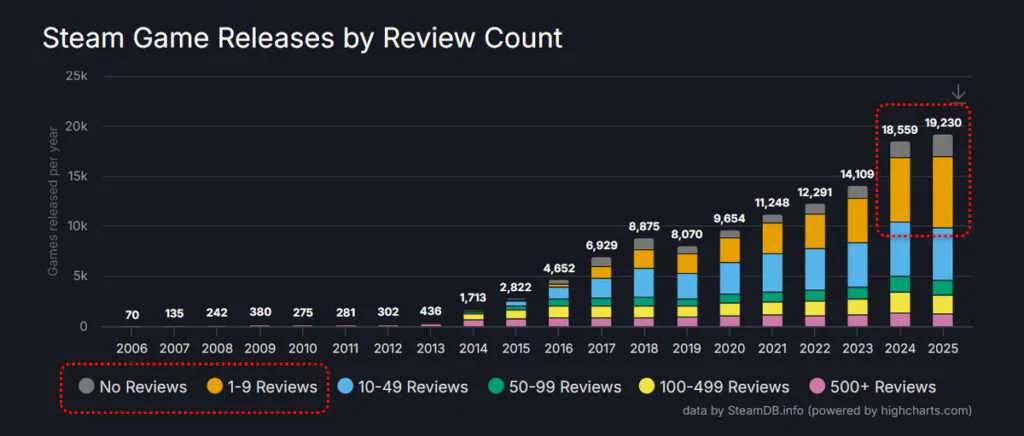
This pattern reflects the trade-offs of Steam’s open publishing model. The system has made distribution more accessible to developers, but it has also resulted in an oversaturated marketplace. As a result, visibility has become the most limited resource, particularly for independent studios and solo developers without significant marketing support.
The data suggests this is part of a broader, ongoing pattern. Of the approximately 19,000 games launched the previous year, slightly more than 20 percent reached the player threshold needed to enable Valve’s community features, commonly viewed as a sign of a minimally viable audience.
The issue isn’t simply that these games are bad. Metrics from SteamDB and industry watchers show plenty of creative, well-made projects getting lost in the crowd. Some recent standouts include a lightning-fast parkour game about an armless priest in hell, or a skateboarding game where you pull tricks on fish instead of boards. Without a way to get noticed, even great ideas can fade almost immediately.
Valve has deployed multiple discovery mechanisms, from wishlists and algorithmic queues to curated lists and community tagging, all built around personalized recommendations. Despite these efforts, the logic driving front-page exposure and overall store visibility remains largely opaque, limiting predictability for developers and transparency for users.
Because Steam doesn’t offer much insight into how visibility really works, developers have started getting creative. Some team up with key resellers, while others rally around community-driven genre tags like “survivors-like” or “bullet heaven” to stand out. It helps a little, but getting noticed is still one of the toughest parts of releasing a PC game.
Steam has made it easier than ever to release a game, and in that sense, it’s done exactly what it set out to do. The downside is the sheer amount of noise. With more games launching every year, plenty of them slip by without anyone really noticing they’re there. The big question now is how Valve and developers can make sure good games don’t get buried before players ever see them.
Maybe you would like other interesting articles?