

France has set an autumn deadline for government ministries to formalize strategies aimed at reducing dependence on U.S.-based software ecosystems. The initiative targets widely used platforms like Windows, Office, Zoom, and Google Docs as part of a broader digital sovereignty agenda.
According to Linuxiac, the Inter-ministerial Digital Directorate (DINUM) has introduced a roadmap to shift French government systems away from American-controlled software. The plan involves replacing Windows with Linux and adopting European-developed applications.
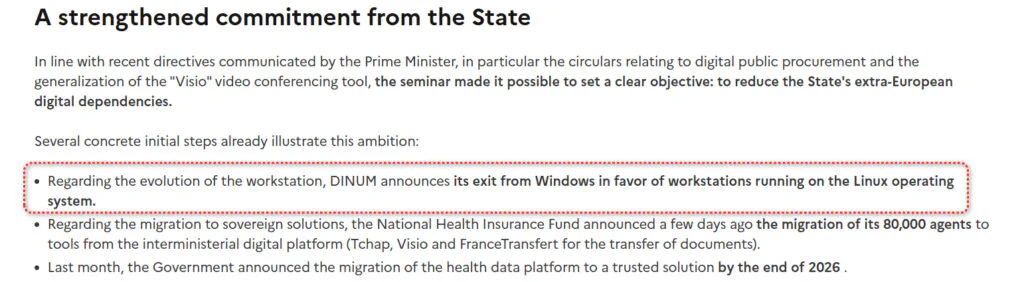
France has set a fall deadline for ministries to formalize strategies to decrease reliance on non-European technologies across a broad stack. This includes endpoints, collaboration platforms, security infrastructure, AI systems, databases, virtualization layers, and networking hardware.
DINUM pointed to several domestic solutions already in operation, including the Tchap messaging platform, the Zoom alternative Visio, and FranceTransfer for file sharing. The agency plans to hold its first meetings in June to begin shaping public-private partnerships tied to the initiative.
The announcement marks the clearest signal yet that European governments are preparing to scale back their dependence on U.S. tech giants such as Microsoft, Google, and Apple. While the European Union has spent years trying to rein in big tech, France has consistently been one of the most outspoken countries challenging American dominance.
Last year, France accused the United States of trying to weaken enforcement of the Digital Services Act and Digital Markets Act, two major EU laws aimed at ensuring interoperability and fair competition, particularly among companies like Apple. Openness and interoperability continue to underpin Europe’s digital sovereignty efforts, as governments increasingly adopt open-source tools outside U.S. control.
France and Germany launched Docs last March as an alternative to Google Docs, supporting collaboration as well as offline and cloud-based editing. Later that year, Schleswig-Holstein announced plans to replace Microsoft Teams with LibreOffice, an open-source alternative to Microsoft Office.
In October, the International Criminal Court revealed plans to adopt a similar platform known as OpenDesk. France followed in January with its transition to Visio, while a European consortium introduced an OnlyOffice-based fork called Euro-Office last month.
As concerns continue to mount around Microsoft and other U.S. tech giants, Linux has steadily gained attention from governments and everyday users alike.
Maybe you would like other interesting articles?