

Months of rumors about Microsoft’s next gaming device have now been cleared up. Xbox CEO Asha Sharma confirmed that the company is developing a new console, known internally as “Project Helix,” intended to narrow the divide between Xbox hardware and Windows PC gaming.
This is the first time Microsoft has openly confirmed its hybrid console idea. For months, rumors have suggested the company was building a system that could handle both Xbox games and regular Windows applications.
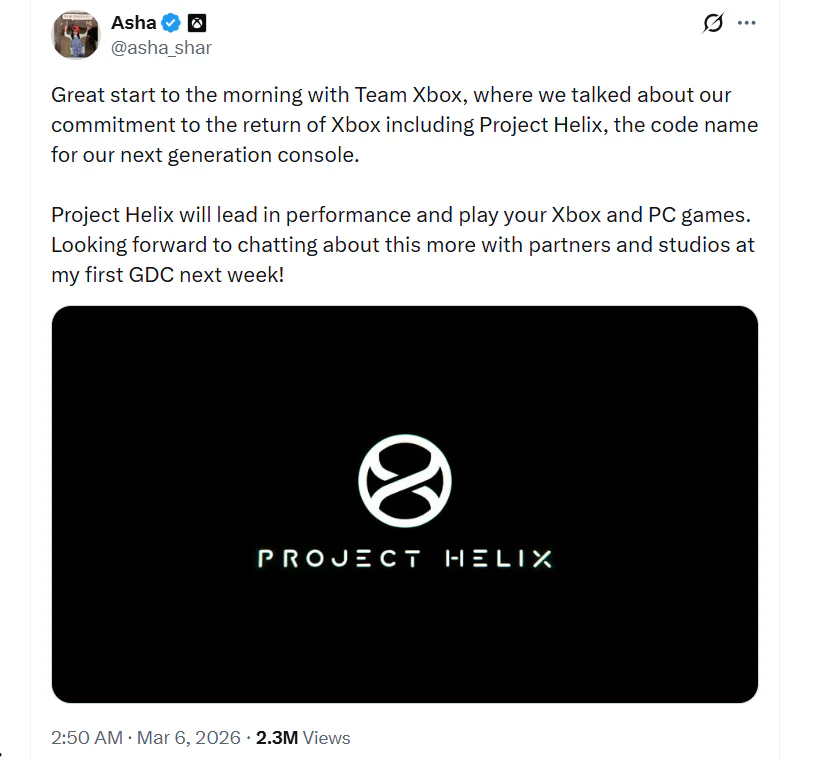
Asha Sharma, who recently took over leadership of Xbox after Phil Spencer stepped down, said Project Helix is being designed to lead the console market in raw performance. The system will support the existing Xbox game library while also running PC titles, potentially making it Microsoft’s most flexible gaming platform yet.
Since stepping into the top Xbox role last month, Asha Sharma has been talking about what she calls “the return of Xbox,” hinting at a stronger push for dedicated gaming hardware again. Project Helix seems to line up with years of rumors that Microsoft might eventually blend its console and PC ecosystems in new ways.
Industry rumors circulating since last year suggested the next Xbox could operate much like a pre-built PC, while still supporting the full library of Xbox Series X games. The confirmation of Project Helix appears to back up those reports and hints at a future where the line between console and PC gaming becomes increasingly indistinct.
The hybrid strategy may also reach beyond Microsoft’s own devices. Reports suggest partners such as Asus and other OEM manufacturers could introduce their own interpretations of the hybrid console, building a broader ecosystem powered by Windows gaming.
The idea lines up with what Satya Nadella, the CEO of Microsoft, has been saying lately about creating a more “universal” gaming ecosystem. He’s often pointed to Microsoft Windows as the company’s biggest gaming platform, and Microsoft is reportedly trying to make gaming on Windows smoother across different types of devices.
According to people familiar with the plans, Microsoft is working on a set of updates for Microsoft Windows to make PC gaming feel more like playing on a console. The upgrades could include better graphics drivers, smarter handling of background tasks, improvements to the graphics system, and a cleaner interface.
The Asus ROG Xbox Ally, a handheld gaming PC currently available, is being used to test new features planned for both the next Xbox and Windows 11. One of the most notable is the “Full Screen Experience,” which allows the system to boot directly into a gaming interface instead of the Windows desktop, with navigation handled entirely by a controller. The feature is presently available to testers through the Windows Insider Program.
Several leaks have outlined what Project Helix might look like internally. The system is reportedly built around a custom APU from Advanced Micro Devices known as Magnus. Early information suggests it could feature 10 CPU cores based on the upcoming Zen 6 architecture, paired with graphics compute units using the next-generation RDNA 5 design.
Next to the hardware inside the Xbox Series X, which still relies on Zen 2 CPUs and RDNA 2 graphics, the Magnus chip could be a big step forward. It’s expected to boost performance in things like rendering, upscaling, ray tracing, and maybe even path tracing.
Although Advanced Micro Devices has suggested the chip could enter production next year, Microsoft has reportedly not finalized an internal launch timeline for the console.
The growing number of console-like PC gaming devices, including Project Helix and the next iteration of the Steam Deck from Valve, could already be influencing competitor plans. Some reports suggest Sony is reassessing its PC port strategy as living-room PC gaming becomes increasingly viable.
If successful, these devices could turn PC gaming into a direct competitor to living-room consoles. That space has long been dominated by hardware from Microsoft, Sony, and Nintendo.
Sharma has indicated that additional details about Project Helix will be shared with developers and partners at the 2026 Game Developers Conference, which begins next week.
Maybe you would like other interesting articles?