
People have been saying for years that Linux gives handheld gaming PCs a nice performance boost. SteamOS or builds like Bazzite usually ran games better, even on something like the ROG Ally, which was tuned around Windows. But recent tests tell a different story. With systems that have discrete GPUs, the Linux lead mostly disappears, and sometimes Windows pulls ahead.
Fresh benchmarks from Ars Technica suggest the Windows-versus-SteamOS performance debate isn’t as straightforward as once thought. To test the claim, the publication assembled a desktop setup resembling the rumored specs of Valve’s upcoming Steam Machine, powered by an AMD Ryzen 7 7700X and 32GB of DDR5 memory. From there, they ran a suite of titles across multiple Radeon GPUs, including the 8GB RX 7600.
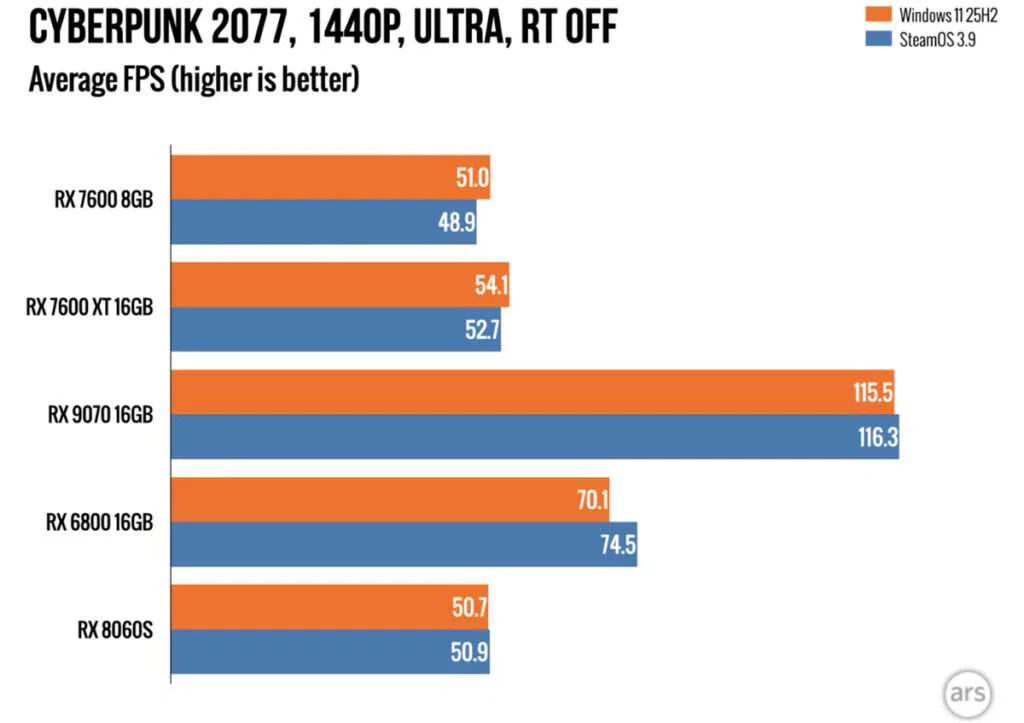
Many of the measured games showed minimal performance differences. Cyberpunk 2077, Returnal, and Assassin’s Creed Valhalla performed at nearly identical levels on both operating systems. This is particularly notable for SteamOS, which relies on Proton to translate DirectX calls intended for Windows.
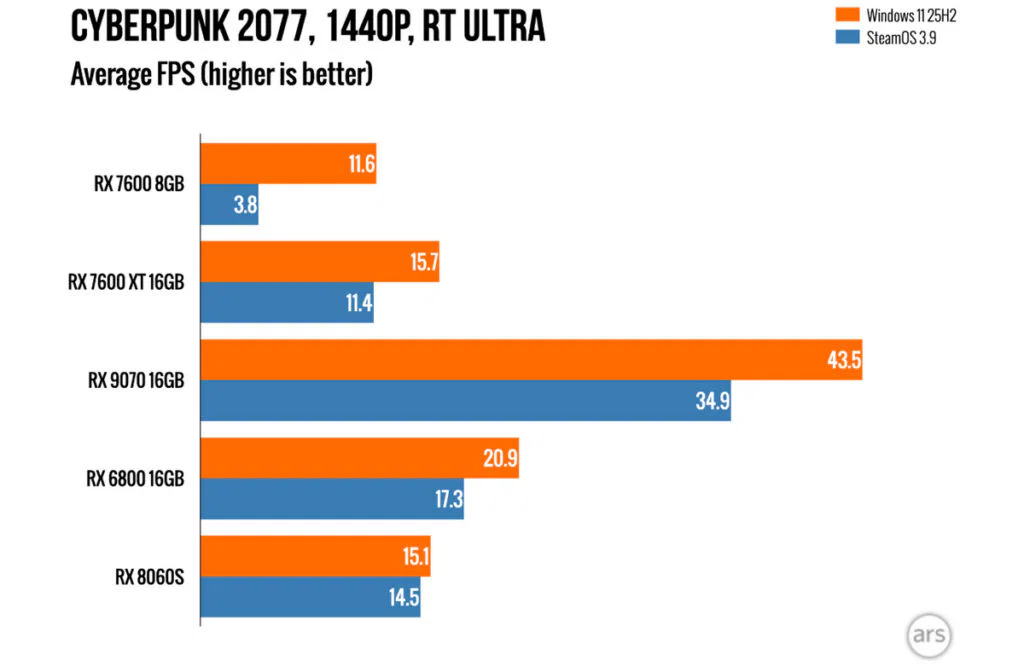
The comparison changes under higher graphical demands. When ray tracing was activated, Windows generally outperformed SteamOS. In Cyberpunk 2077, with the Ultra Ray Tracing setting, Windows showed a clearer lead. Both operating systems encountered performance drops on the 8GB RX 7600 due to limited VRAM, though SteamOS was impacted more significantly.
In some games, the divide wasn’t subtle at all. Forza Horizon 5 kept things even on the Radeon 780M, but as soon as dedicated GPUs entered the picture, Windows began to run away with the lead. Then came Borderlands 3, which didn’t bother with nuance; it was faster on Windows in every test, just like the earlier handheld results hinted.
The repeated performance challenges on the Radeon RX 7600 are significant. Valve’s forthcoming Steam Machine is expected to use a comparable GPU with the same 8GB VRAM capacity. The benchmarks imply that SteamOS and Proton may amplify performance drops in low-VRAM conditions, an issue Valve is reportedly aware of and actively improving.
Ars Technica conducted its testing using the current public release of SteamOS, a build still largely tuned for the Steam Deck and its integrated GPU. Valve has since confirmed that new drivers and broader optimization work are underway ahead of the Steam Machine’s launch early next year.
The findings provide context for SteamOS not being available as a general-purpose release. Valve plans to support both handheld and desktop systems, but the data indicates the software still requires additional testing and optimization, particularly for discrete GPUs, before a broader release is appropriate.
There’s no single answer here. On handheld hardware, SteamOS feels like a cheat code, efficient, smooth, and tuned. But bolt in a larger GPU, and the balance shifts, sometimes sharply in Windows’ favor. For anyone watching the Steam Machine take shape, the message is clear: Valve has one more mountain to climb before it can claim a true living-room replacement.
Maybe you would like other interesting articles?