

Imagine a future where every subtle movement matters, the hum of a car, the steady rush of water, or the quiet bend of a knee. Each motion becomes a tiny source of power. No batteries, no charging, just energy captured from life in motion. That future is beginning to form through a nanoscale generator made from something surprisingly ordinary: silicon and water.
Researchers in Hamburg have developed a triboelectric generator that can harvest energy from mechanical pressure and fluid motion. The system could eventually support battery-free sensors for industrial machinery, wearable devices, and other connected technologies.
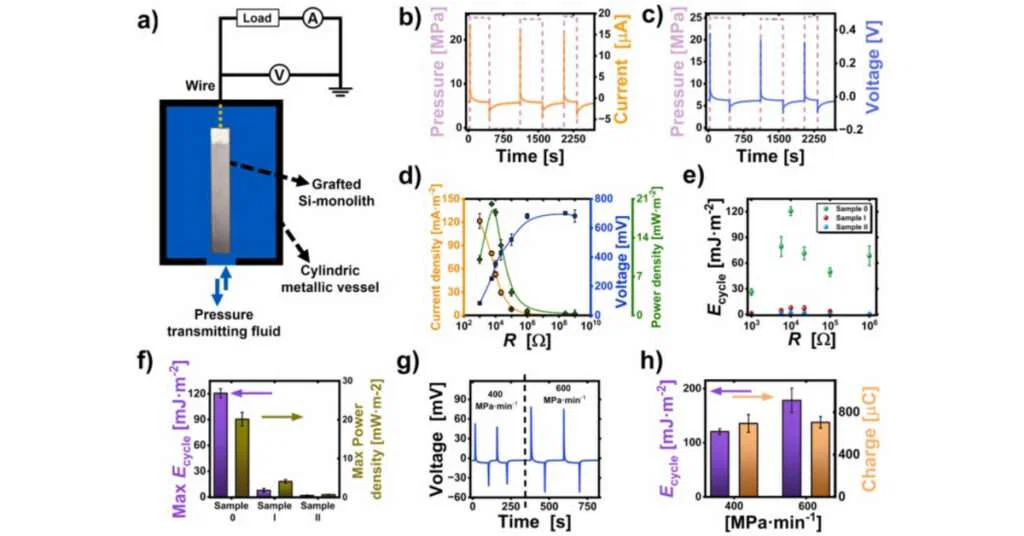
The generator is built around a carefully engineered silicon component. The researchers created a single silicon structure that is conductive, nanoporous, and hydrophobic. While conductivity is common in treated silicon, achieving all three properties together, especially with controlled nanoscale porosity and water repellency, is a meaningful advancement.
This combination allows precise control over how water enters, moves through, and exits the microscopic pore network. The energy conversion relies on triboelectrification, the same phenomenon that causes a spark when you shuffle across a carpet and touch a doorknob. Here, however, the charge is generated by water forced in and out of the nanopores, rubbing against the silicon surfaces.
According to the researchers, the device’s design ensures that the charge formed at the interface isn’t lost. Instead, the system channels it into a usable electrical output.
The researchers highlight a conversion efficiency of approximately 9 percent, currently the highest reported for liquid-solid triboelectric systems. The result indicates that a meaningful share of the mechanical input from water movement is successfully transformed into electrical output.
The researchers point out that this milestone is especially meaningful because triboelectric systems are known for uneven and often low efficiency. Reaching this level brings the technology closer to meeting the power requirements of real-world microelectronics and sensor systems.
The researchers believe the technology could support self-powered sensor systems that harvest energy from their surroundings. The range of possible applications is broad:
- Smart Infrastructure & Vehicles: Embedding generators in vehicle suspension systems to convert shocks and vibrations into power for performance and safety sensors.
- Health & Wearables: Integrating them into sportswear or medical textiles to harvest energy from body motion for health monitors.
- Haptic Robotics & Sensing: Creating touch or motion-activated systems where the interaction itself generates the signal needed for sensing.
- Environmental Monitoring: Deploying self-powered sensors for water detection or flow monitoring in remote locations.
A key advantage is that the device uses readily available materials: silicon, which is standard in electronics, and water.
The researchers note that these material choices aren’t merely conceptual; they have practical implications. Using common substances could make scaling and commercialization easier than with systems built from rare or specialized compounds.
This research aligns with a broader international push to harvest energy from the environment. Similar efforts include metro turnstiles in France that generate electricity from passenger movement and experimental systems that draw power from slow airflow over water droplets.
All of this points to a bigger change in thinking. Instead of ignoring the constant motion around us, we’re starting to see it as energy waiting to be used. The silicon-water nanogenerator is one step in that direction, showing how everyday movement could be turned into power, right down to the smallest pores.
Maybe you would like other interesting articles?