
This week, one screenshot quickly spread across tech circles and reignited debate: has ChatGPT begun experimenting with advertisements?
Kol Tregaskes shared the screenshot on X, and it caught a lot of people off guard. Right in the middle of a normal chat, ChatGPT suddenly suggested: “Find a fitness class › Connect Peloton.” Most people took one look and thought, yeah… that’s an ad.
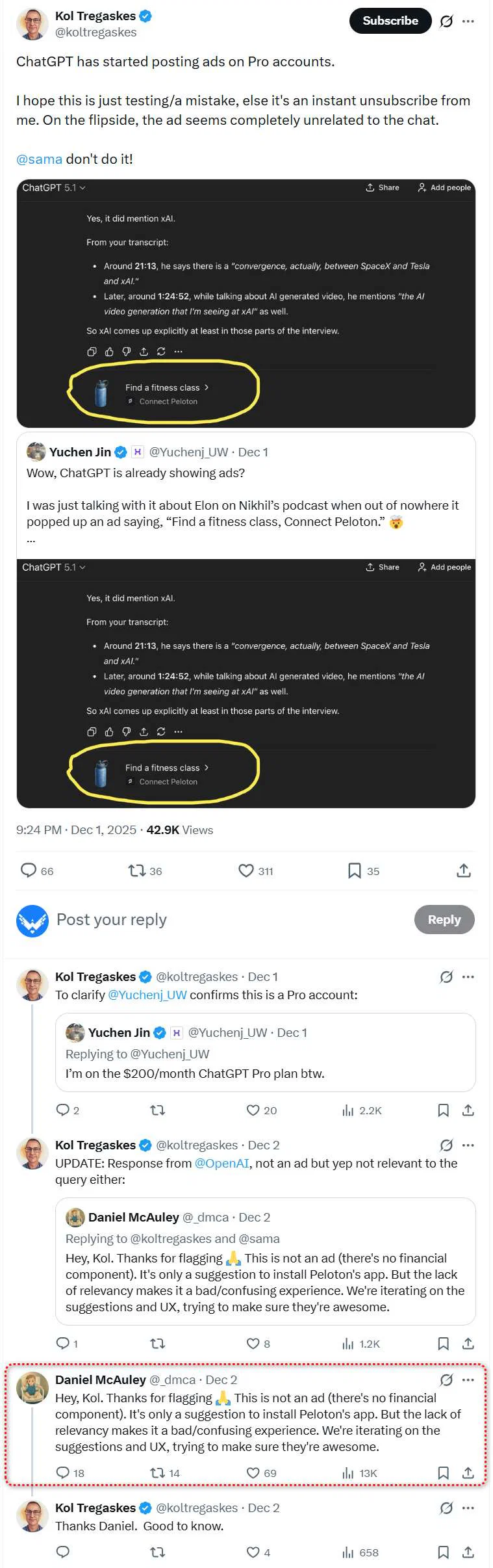
Tregaskes voiced what many were already thinking: “If OpenAI is intentionally pushing ads to its $200-per-month Pro users, that’s a deal-breaker.” The comment captured the growing frustration of people who believed premium pricing meant a clean, uninterrupted experience.
The concern quickly gained attention. Yuchen Jin, co-founder of Hyperbolic, reposted the screenshot and commented, “Wow, ChatGPT is already showing ads?” He later mentioned he had also encountered a similar Spotify prompt while discussing Elon Musk, noting that it had no relevance to what he was talking about.
Reactions came fast. Premium subscribers, in particular, were not happy. And it wasn’t just Peloton; people started sharing screenshots of random Spotify prompts too, sometimes even when they were already paying Spotify users. Jin’s post pulled in almost 470,000 views, and the comments were full of people worried that ChatGPT conversations might turn into ad space.
As concern grew, OpenAI issued a response. Daniel McAuley, who leads data efforts for ChatGPT, replied to the original post and denied that the prompt had any financial intent.
“It’s only a suggestion to install Peloton’s app,” McAuley said, noting that the lack of relevance led to a confusing user experience. He also mentioned that OpenAI is continuing to adjust how these suggestions surface. The message was that this was not an advertisement or a technical issue, but a feature that hadn’t been implemented well.
The Peloton prompt is connected to OpenAI’s testing of its recently launched “Apps SDK,” introduced in October. The system is meant to help ChatGPT suggest and use third-party apps during relevant discussions or when a user names them.
Some big partners are already involved in the early testing phase, companies like Booking.com, Canva, Coursera, Figma, Expedia, Spotify, and Zillow. The idea is for everything to work smoothly together, not to turn chats into ads. But after this week, it’s clear the rollout is still rough, with random suggestions showing up in ways that feel intrusive.
For now, these app suggestions may appear for ChatGPT users across both free and paid tiers, including Plus, Team, and Enterprise, in most regions except the European Union, Switzerland, and the UK. OpenAI has stressed that the prompts are:
- Optional: Users are not forced to engage.
- Context-Dependent: Intended to appear in relevant chats.
- Not Monetized: OpenAI states it doesn’t receive payment for these suggestions.
The company says it is working to refine the system so that future prompts are useful, relevant, and clearly separate from traditional advertising. But for many users already uneasy about the commercialization of AI platforms, this “Peloton moment” is a sharp reminder that as integration accelerates, the user experience matters just as much as the technology behind it.
Maybe you would like other interesting articles?