
Google is about to move much faster with Chrome updates. Beginning in September 2026, the company plans to roll out a new stable version of the browser every two weeks. That’s the biggest shift in the release schedule since 2021, when Chrome updates moved from every six weeks to every four. With the new pace, versions like Chrome 153 and 154 will land just two weeks apart, helping Google deliver security patches, bug fixes, and performance tweaks much sooner.
Although the stable channel will adopt a faster release cycle, Google notes that early-stage builds and experimental channels will continue operating under somewhat different timelines.
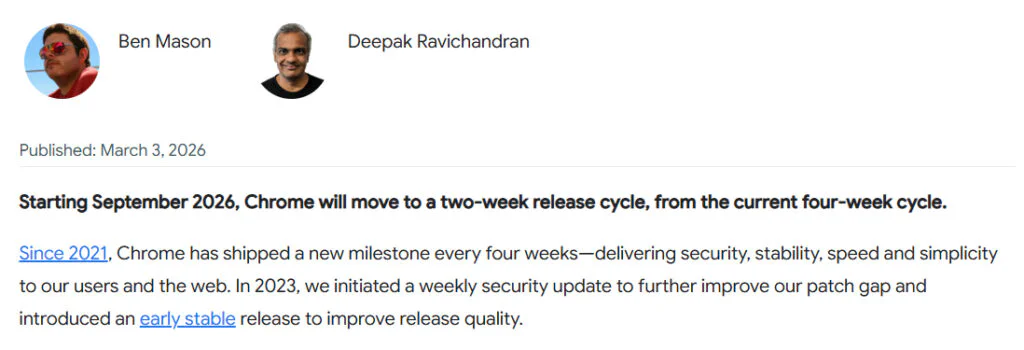
Developers have noticed Chrome’s development cycle gradually speeding up over the years. Since 2021, a new milestone release has arrived every four weeks, and in 2023 Google added weekly security updates to reinforce the browser’s security.
The company says the tighter cadence will shorten the path from development to deployment, allowing enhancements to reach users faster while strengthening the overall web platform.
The new schedule kicks off this fall. Chrome 153 is expected to land on September 8, 2026, and Chrome 154 should follow just two weeks later on September 22. Google says the shift mirrors how quickly the web platform is evolving. Updates will show up more often, but they should also be smaller, which should help avoid major disruptions for users and businesses.
The accelerated schedule won’t be limited to the stable channel. Chrome’s beta releases will also shift to a two-week cycle across all supported platforms, including desktop, Android, and iOS. For the time being, however, the Dev and Canary channels will continue operating on their existing timelines.
Some release tracks will stay the same. Google’s Extended Stable program, introduced in 2021 to give enterprise administrators more time between updates, will continue on an eight-week cycle for Chromebook and desktop platforms. Over time, however, ChromeOS-powered thin clients are expected to move toward the new two-week schedule.
Chrome might be proprietary, but it’s built on Chromium, the open-source project that powers a huge chunk of the web’s browsers today. Even though Chromium is technically community-run, most of the work still comes from Google’s engineers. Since browsers like Opera, Tor Browser, Brave, and Microsoft Edge depend on that same base, changes to Chrome’s release cycle could affect the wider ecosystem too.
Even Mozilla Firefox, one of the few browsers still developed independently, adopted a rapid release cycle in 2011 to keep pace with Google Chrome. As a long-time Firefox user who isn’t particularly fond of frequent software updates, interested to see how Chrome’s latest acceleration might affect the future direction of the Firefox project.
Maybe you would like other interesting articles?