
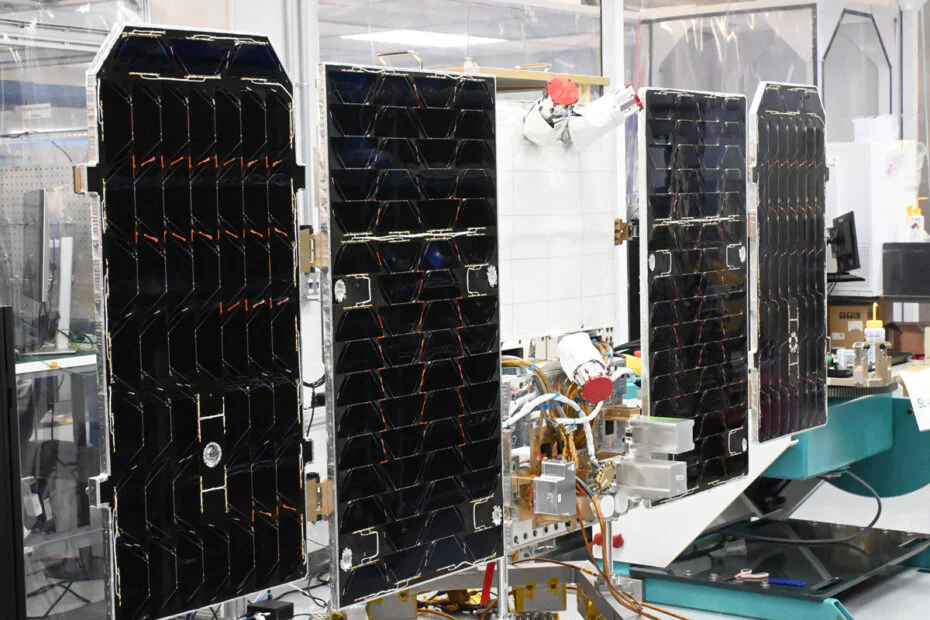
Google plans to launch a small AI data center into orbit as part of Project Suncatcher, a long-term bet on running large-scale AI computing from space. The New York Times reports the launch will test how the hardware holds up against the harsh conditions beyond Earth’s atmosphere.
On October 1, a satellite called MVP will lift off atop a SpaceX Falcon 9, carrying something far smaller than its mission suggests. Inside isn’t a sprawling data center, but just four tensor processing chips, quietly bundled together – together capable of about as much as one ordinary server back on Earth.
The chips will run on just one kilowatt of solar power – roughly the same amount a hair dryer uses. According to Google, that’s enough to put the hardware through its paces in space. The satellite will process basic AI queries for about a year, then remain in orbit for six years total before burning up during reentry.
Before launch, the chips underwent extensive testing to simulate space conditions, including radiation exposure at Crocker Nuclear Laboratory. Radiation poses a real threat to computer hardware, capable of triggering so-called “bit flips” – errors that flip a binary digit from one to zero, or the reverse.
When something goes wrong up there, Google’s solution is very simple – turn it off, turn it back on again, the same trick that’s solved computer problems for decades. Heat, though, is trickier. A custom-built cooling system tries to push it out into the void using layers of conductive material, but even that has its limits: after just 15 minutes, the chips have to shut down and cool off before they can keep working.
The early tests at Crocker reportedly produced strong enough results to justify the next step: sending the chips into orbit. That said, full-scale AI data centers in space remain a distant prospect.
James Manyika, Google’s senior vice president for Research, Technology & Society, cautioned against getting ahead of the story. He said the company doesn’t anticipate having anything practically usable for several years.
Brandon Lucia, a professor of electrical and computer engineering at Carnegie Mellon University, told The New York Times that scaling up the project would be no small feat. Turning a single satellite into a sprawling network functioning like a giant data center, he said, would require years of work and massive funding – along with a host of additional engineering challenges at that scale.
These additional problems are significant, despite Elon Musk’s claims that putting AI data centers in space would be easy. Radiation and bit flips are already difficult to manage with just four chips, let alone thousands. Cosmic rays present another challenge – they are physical particles moving at high speed through space, capable of punching through and melting semiconductor junctions.
Launch costs are also steep. A single Falcon 9 launch costs around $74 million, for instance.
Scaling up the cooling system appears to be a major challenge. Google’s current system only lasts 15 minutes, even with the small amount of heat generated by four chips. Standard heat dissipation methods don’t function in space. Power is another factor – a solar array built for four chips is very different from one large enough to run a full-scale data center.
Despite these challenges, Google plans to move forward with scaling the project. The company aims to launch two more satellites next year, with a longer-term goal of deploying 80 satellites flying in close formation to handle AI processing together. Google is also considering a much larger satellite, roughly the size of a football field. It has not disclosed how much funding is going into the project.
Maybe you would like other interesting articles?