
Anthropic is starting to add invisible digital watermarks to text created by newer versions of Claude. The goal is to make it easier to tell when something was written by AI instead of a person. The change applies worldwide to Claude models released from August 2 onward and also helps Anthropic meet the EU’s AI Act requirements while making the source of online content clearer.
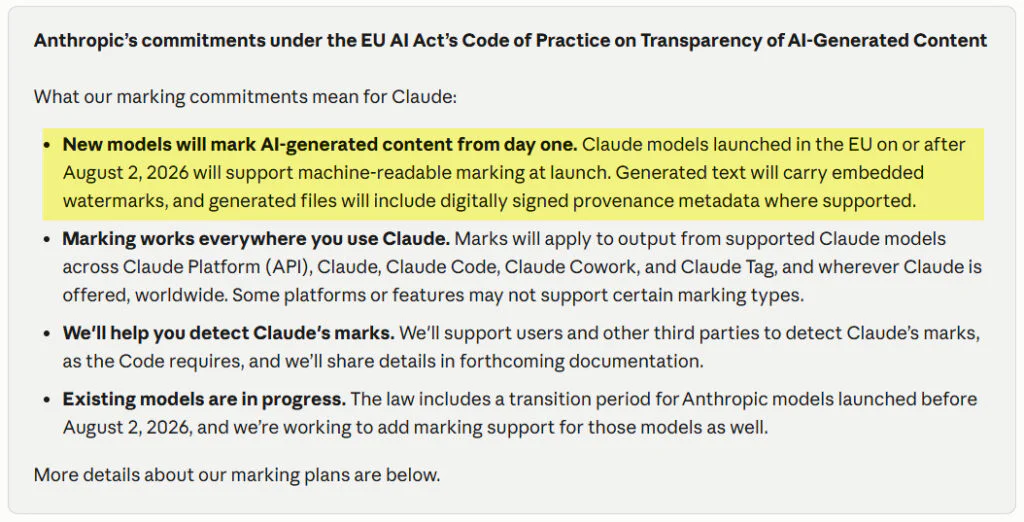
The watermark does not change what the text says, and Anthropic says it can remain intact even after some editing when the content is copied and pasted. The company sees the feature mainly as a way to make AI-generated content easier to identify. Anthropic said that as AI writing becomes more common, knowing where content came from can give people more context when reading it. The company also said the change helps it meet its legal requirements by adding machine-readable marks to Claude’s output.
Beyond text watermarks, Anthropic’s latest update will also attach signed provenance metadata to other files generated by Claude. The company says it is working on bringing watermarking to older Claude models as well. Anthropic also plans to release tools that will let users check whether the marks are present.
The system also comes with some important limitations. Anthropic says the watermark should be treated as a signal that content was processed by Claude, rather than definitive proof that the AI wrote it. A detected mark only suggests that Claude may have handled the content at some point. Even simple tasks such as proofreading or translating human-written text can trigger a watermark. At the same time, content without a watermark cannot automatically be considered human-written, since heavy editing, paraphrasing, translation, or combining it with other text can remove the mark.
The introduction of AI watermarking comes as concerns about synthetic content continue to increase. Barnes & Noble faced criticism in May after its CEO said the company was open to AI-generated books if they were clearly labeled. The discussion has added to broader concerns about the growing volume of AI-produced material in the publishing industry. In September, Anthropic agreed to a $1.5 billion settlement with dozens of authors who claimed the company had used their copyrighted books to train its models without permission.
Anthropic is not the first company to use embedded identifiers for AI-generated content. Google DeepMind introduced SynthID for AI-generated text and video in 2024, building on an earlier version released in 2023 that focused on synthetic images.
Maybe you would like other interesting articles?