
A recently published Microsoft support document has exposed the fragility of the Windows shell, confirming that standard updates are now causing core components to fail for enterprise deployments. The issue has reignited criticism that Microsoft’s AI-first agenda is overshadowing reliability in its flagship platform.
In its KB5072911 notice, Microsoft cautions that cumulative updates released after July 2025, namely KB5062553 and KB5065789, may disrupt key interface elements on certain managed Windows 11 24H2 and 25H2 devices. The company attributes the issue to failed registration of core XAML components, particularly when the update is applied before any user signs in.
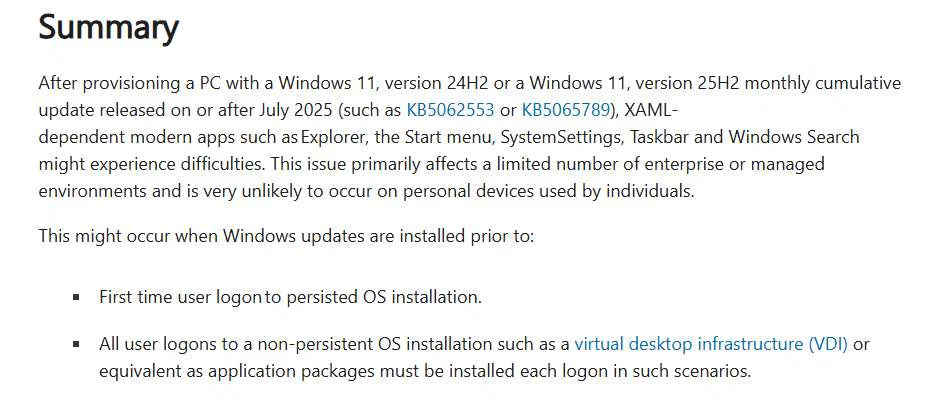
The outcome is a series of failures that leave the system barely functional. Users affected by the issue may experience:
- Crashes or black screens in File Explorer (explorer.exe)
- A Start menu that refuses to open
- A missing or broken taskbar
- Crashes of the shellhost.exe component
- A failure to launch other applications built on XAML frameworks
According to Microsoft, the issue is currently limited to enterprise systems, and administrators can apply PowerShell-based workarounds. However, the failure exposes a structural weakness. Because XAML underpins much of the Windows interface and related app frameworks, a failure at this level raises concerns about the reliability of Windows updates.
All of this is happening right when Microsoft is pushing the idea of Windows becoming an “agentic OS,” with different AI agents working on their own in separate spaces. For a lot of people watching this unfold, the timing feels almost too ironic.
“How can we trust Microsoft to manage a chorus of AI ‘first-class users’ doing complex tasks,” one commenter on a popular tech forum noted, “when it can’t reliably update the basic graphical shell without it falling apart?”
More and more people are starting to think Microsoft isn’t treating Windows stability as a priority anymore. That feeling only gets stronger when things like CVE-2025-9491, a serious LNK vulnerability that’s been abused for years, get “fixed” with almost no details about what changed or how.
There’s growing concern that as Microsoft prioritizes AI integration, the reliability of Windows is slipping. For organizations that rely on stable systems and for users who expect predictable behavior, messaging about the future of AI feels out of sync with ongoing issues affecting core functionality.
If there’s one lesson from the KB5072911 mess, it’s this: before Windows starts running itself with AI, Microsoft needs to figure out how to update it without breaking things.
Maybe you would like other interesting articles?