
Instagram CEO Adam Mosseri warns that generative AI has effectively ended visual trust on the internet. As synthetic media becomes harder to distinguish from reality, he argues that skepticism should become a baseline assumption for all online interactions.
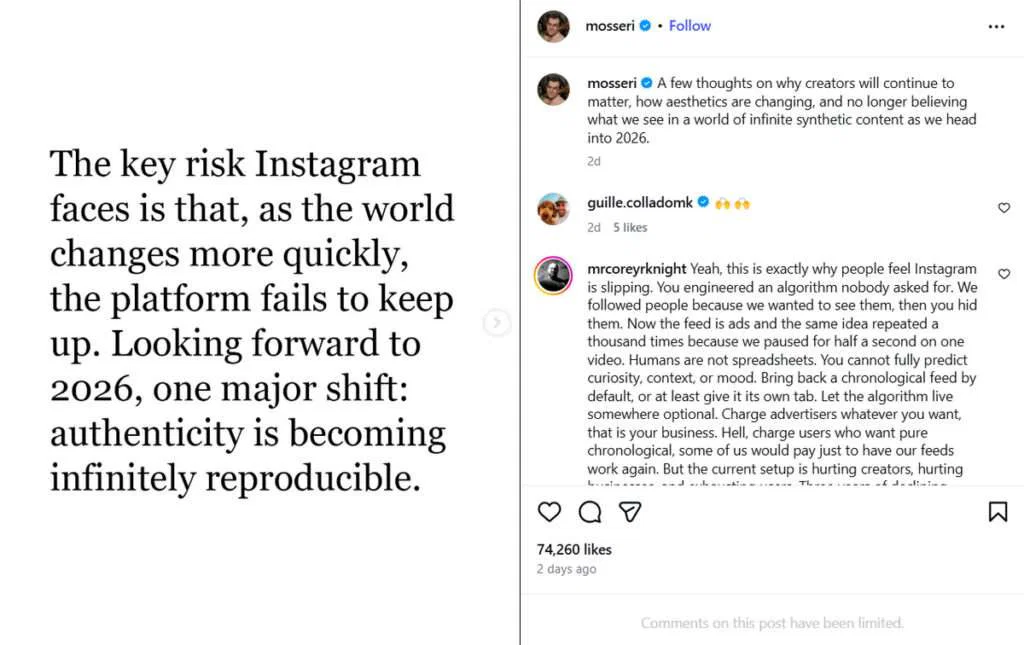
Speaking in a year-end reflection, Mosseri framed the moment as a fundamental reset for social media. The era of a trusted, personal feed is over, he said, as generative technologies make visual authenticity increasingly uncertain.
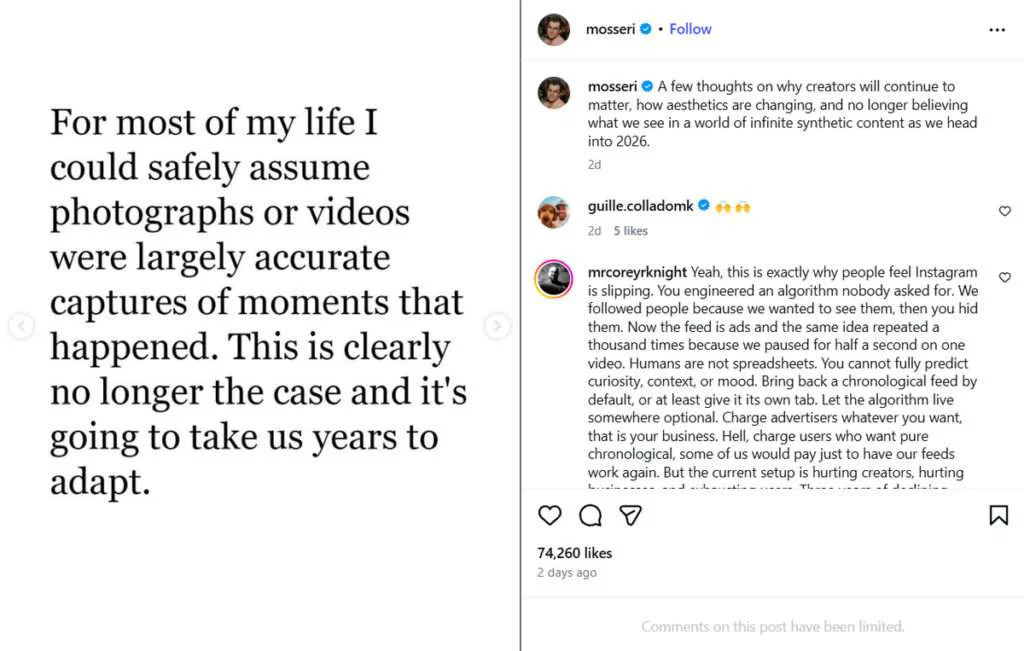
“For most of my life, I could safely assume photographs or videos were largely accurate captures of moments that happened,” Mosseri wrote. “This is clearly no longer the case, and it’s going to take us years to adapt.”
He described the change as a shift “from trust to verification,” predicting it will be an uncomfortable adjustment. Humans are predisposed to believe visual information, he said, making AI-driven deception particularly challenging to counter.
Mosseri isn’t alone in sounding the alarm. Last year, commentator Sarah Jeong said we’re heading toward a world where the first instinct is to doubt a photo, not trust it, because realistic fakes are now so easy to make. Even though Mosseri was speaking specifically about Instagram, his message points in the same direction.
Mosseri also talked about how platforms like Instagram need to adapt. That means better creative tools, clearer labels on AI-generated content, ways to verify what’s real, more transparency around who’s posting, and algorithms that give original work a boost.
That approach would leave Meta’s systems doing much of the heavy lifting, sorting real photos and videos from fake ones at a time when AI image tools are becoming more widespread.
Mosseri also weighed in on the perceived quality of AI-generated content. He rejected the term “AI slop,” saying there is “a lot of amazing AI content,” but did not cite specific examples or outline Meta’s own initiatives.
In a pointed aside, Mosseri suggested that traditional camera companies may be chasing the wrong problem. Tools designed to deliver hyperrealistic images “making everyone look like a pro photographer from 2015,” as he put it, fail to address the central challenge of the moment: establishing authenticity in an environment saturated with high-quality synthetic media.
Maybe you would like other interesting articles?