
Bolt Graphics made its debut at the CES show prototype with the launch of its Zeus accelerator series, accompanied by ambitious performance claims. According to the company, the top configuration offers a tenfold path-tracing advantage over NVIDIA’s forthcoming RTX 5090, but it still lacks independent validation.
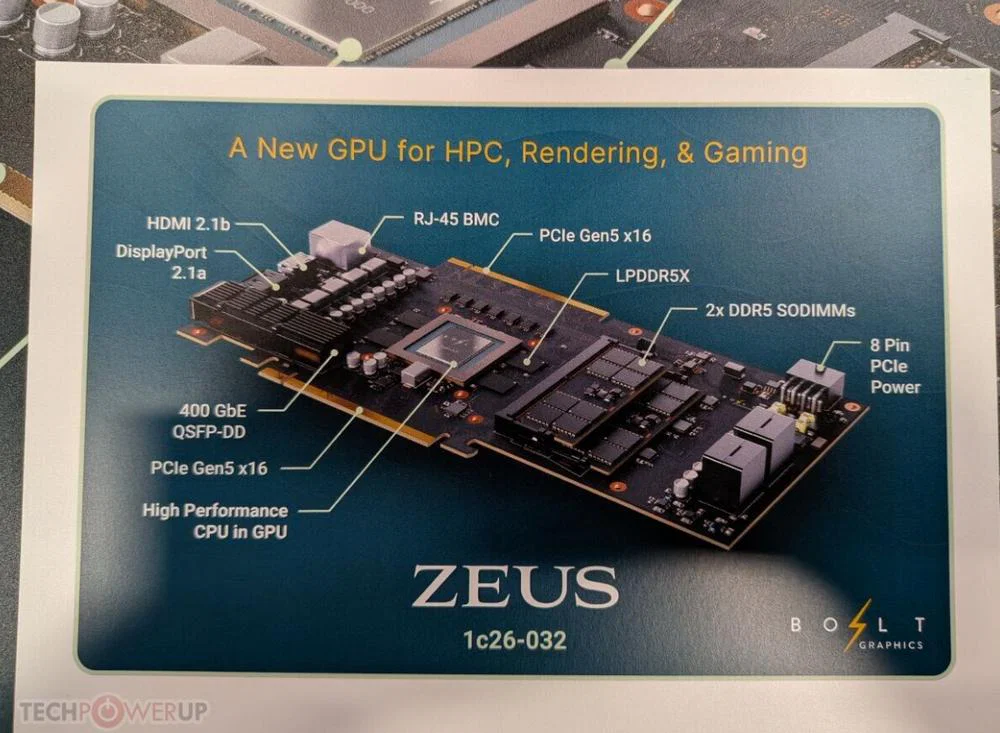
The prototype Zeus accelerator showcased by Bolt Graphics departs from traditional GPU designs, integrating compute, memory, and I/O in a dense, server-like form factor. Its defining specification is a 384GB maximum memory capacity, combining LPDDR5X, DDR5, and 128GB of soldered VRAM. Additional features include four DDR5 SO-DIMM slots, an 800Gbps memory interface, and a 225W TDP delivered via a single 8-pin PCIe connector.
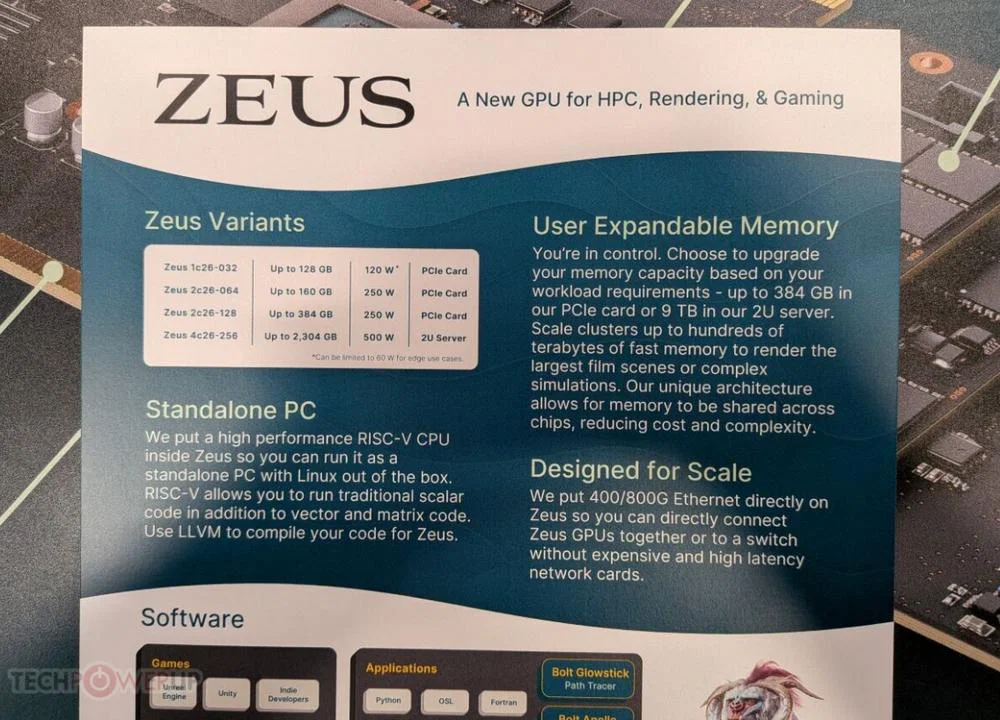
The Zeus’s I/O and management features point firmly toward data center use. It offers dual PCIe 5.0 x16 connections with CXL 3.0 support, integrated 400GbE and 800GbE QSFP-DD networking, and a BMC/IPMI controller for remote system control. Display outputs are limited to one DisplayPort 2.1a and one HDMI 2.1b.
Bolt’s performance assertions scale with the number of “processing units” or chiplets in its configurations, all based on internal FP64 math benchmarks:
- Zeus 1C (Single Chiplet): Claims 2.5x the path tracing performance of an RTX 5090. Equipped with 32GB LPDDR5X.
- Zeus 2C (Dual Chiplets): Claims 5x RTX 5090 performance. Supports up to 128GB of LPDDR5X.
- Zeus 4C (Quad Chiplets): The flagship server platform, which Bolt says can deliver the headline 10x path tracing performance. This configuration boasts four I/O chiplets, up to 256GB of LPDDR5X, and a staggering 2TB of total DDR5 memory.
In a separate benchmark for electromagnetic (EM) simulation, Bolt claims the Zeus 4C is up to 300 times faster than an NVIDIA B200 Blackwell GPU under controlled conditions.
Despite the strong specifications and confident claims, several important questions remain open, tempering the initial excitement.
So far, it’s all Bolt’s own numbers. There’s no independent testing, no hands-on reviews, and no public benchmarks to back up the “10× RTX 5090” claim, particularly when the RTX 5090 itself isn’t even out yet.
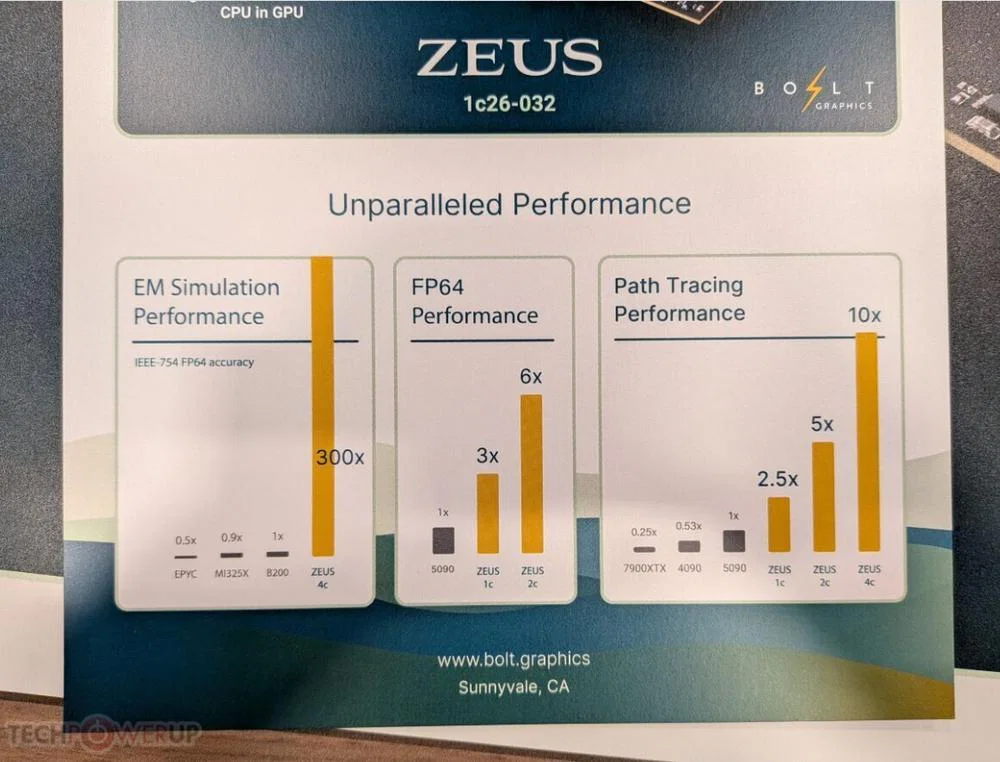
Bolt has limited its disclosed benchmarks to FP64 double-precision workloads used in scientific and compute applications. No data has been released for rasterization or real-time rendering, which are central to gaming and many professional visualization tasks. Although the hardware includes TMUs and ROPs, the extent of its rasterization performance remains unclear.
Bolt has not provided a firm launch schedule, indicating only that Zeus is expected to arrive in 2026. Pricing, final specifications, and architectural details of its proprietary chiplets have not been made public.
The performance claims are ambitious and could be disruptive if validated. However, until we see silicon in the hands of reviewers and integrators, these remain specs on a page.
Maybe you would like other interesting articles?