
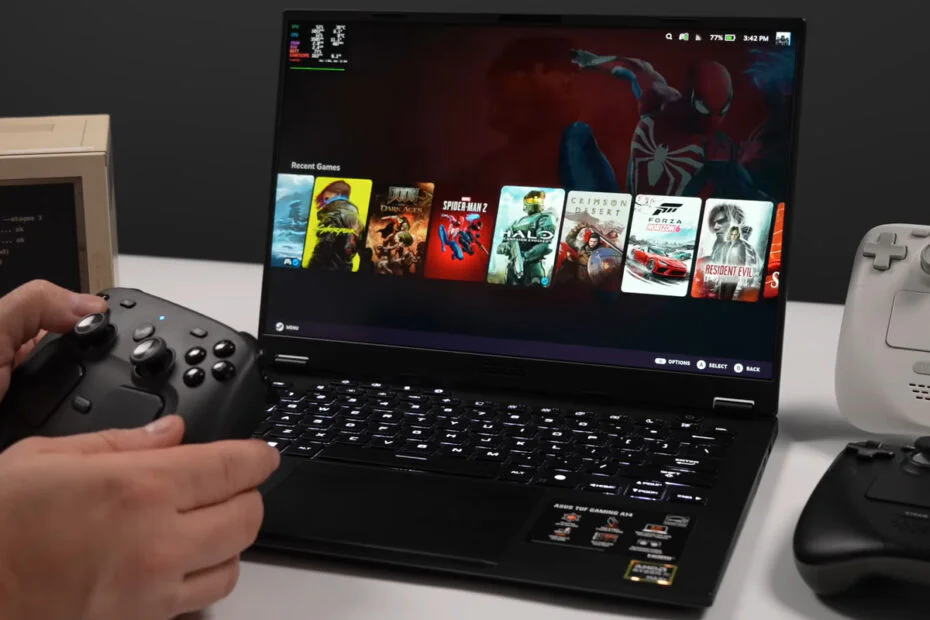
While Valve has not introduced a dedicated SteamOS-powered gaming PC, one content creator installed the operating system on a high-end Windows laptop to see how it would perform. Gaming benchmarks from the test suggest that opening SteamOS to third-party hardware was a well-judged move by Valve.
The experiment came from the YouTube channel ETA Prime, which used the official Steam Deck recovery image to install SteamOS 3.9 on an Asus TUF Gaming A14. The system featured AMD’s Ryzen AI Max+ 392 APU based on the Strix Halo platform, with 12 Zen 5 cores, a Radeon 8060S integrated GPU, 32GB of LPDDR5X-8000 memory, a 14-inch 2560×1600 display running at 165Hz, and a 73Wh battery.
The test confirmed that the TUF Gaming A14 is capable of running SteamOS natively, supporting both gaming mode and the desktop environment. Core features such as Wi-Fi, Bluetooth, USB ports, and peripheral devices functioned out of the box without additional adjustments.
With SteamOS fully installed, the testing shifted to gaming performance across a mix of AAA and indie titles. Results were consistently strong, with Halo: Campaign Evolved running at roughly 70 FPS at 1440p using the High preset and Medium FSR. Crimson Desert also performed well at 1440p on High settings, while Spider-Man 2 exceeded 80 FPS at the same resolution on High settings with FSR turned off.

Not every game was an easy win. Doom: The Dark Ages pushed the hardware much harder, with Ultra settings proving too much and even High needing Balanced FSR to stay above 60 FPS. Cyberpunk 2077 fared better, maintaining a solid 60 FPS at 1440p on High with FSR 2.1, while frame generation was left off to show the system’s actual performance. Running on battery, the laptop lasted around two hours and 25 minutes at 800p, or about one hour and 40 minutes at 1200p.
Performance was even stronger in indie games. Hollow Knight: Silksong ran smoothly at 1200p with a constant 60 FPS, while power consumption stayed below 16W during testing. Battery life for Silksong and comparable indie titles was estimated at between four and seven hours, depending on the display resolution and graphics settings.
Although an official SteamOS installer for standard PCs is still unavailable, the test demonstrates that the operating system runs effectively on current AMD laptop hardware. The results also highlight the potential of Valve’s broader hardware strategy, with growing interest in wider SteamOS support.
Maybe you would like other interesting articles?