

During the Game Developers Conference, Valve released the official verification requirements developers must meet for games to run on its next-generation hardware, including a new living room PC and VR headset.
The Steam Deck’s verification system has been a central part of the handheld since launch, helping players easily identify which games run smoothly. Valve is now bringing a similar, slightly adjusted system to its upcoming devices: the Steam Machine and the standalone VR headset, Steam Frame.
According to an information booklet published by Valve, the verification standards differ widely depending on the device’s capabilities and intended use. The upcoming Steam Machine will face far more relaxed requirements than the Steam Deck, largely because it is expected to offer roughly six times the available performance. In contrast, locally installed games on the Steam Frame will need to meet stricter standards due to the performance demands of virtual reality.
Valve confirmed that any title already labeled “Steam Deck Verified” will automatically qualify for Steam Machine verification. In addition, games that fall short on the Deck only because of default resolution settings or small text will also be approved for the new console without further changes.
However, other compatibility problems, such as performance limitations or issues with SteamOS, will still affect how titles are classified, potentially placing them in the “Playable,” “Unsupported,” or “Test” categories.
The Steam Machine verification guidelines also remove resolution and text legibility requirements. Valve noted that the system may be paired with a wide range of displays, from traditional monitors and TVs to the Steam Frame, so developers are not required to optimize around one fixed resolution.
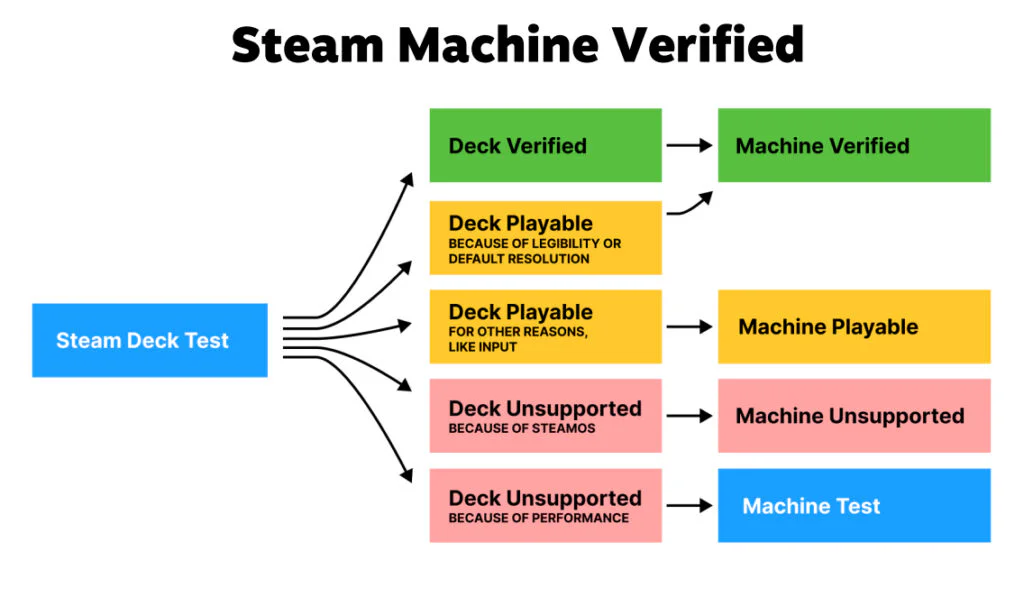
To earn verification, games must support gamepad and gyro controls, allow multiple controllers, even in single-player modes, likely for accessibility, and sustain a stable 30 frames per second at 1080p using minimum graphics settings. Valve also clarified that while it previously mentioned a 4K, 60 fps target for the Steam Machine, that figure assumes the use of upscaling.
The verification approach for the Steam Frame, Valve’s upcoming VR headset, will be handled differently. Valve said the process will focus only on performance and compatibility when games are installed locally on the device. Streaming performance, meanwhile, depends on the host PC, with Valve managing streaming optimizations internally rather than requiring developer involvement.
Testing will cover both VR and non-VR games, as the Steam Frame is capable of displaying traditional media in a virtual theater mode.
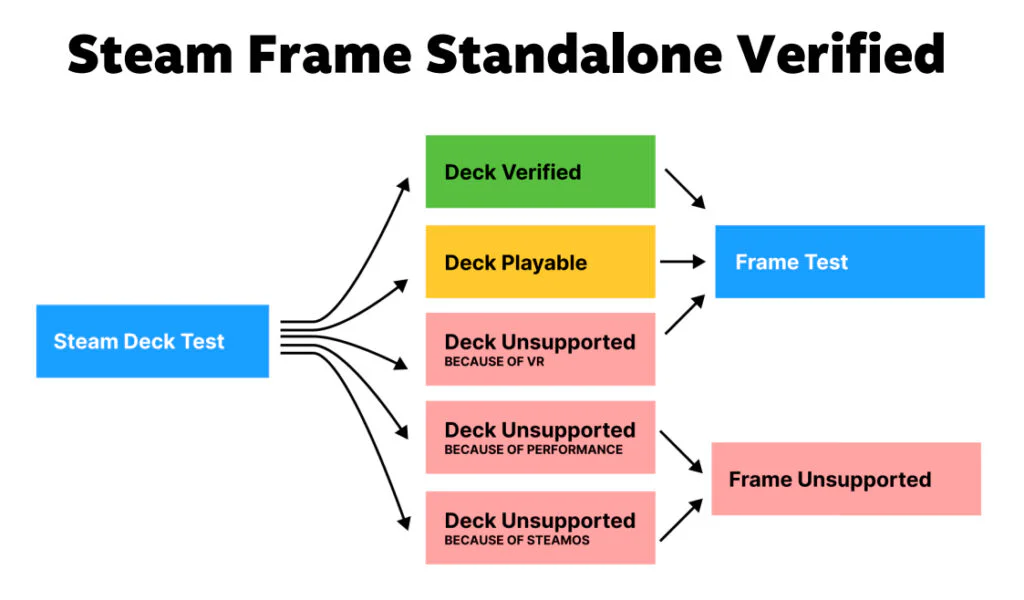
To qualify for verification, games must display clearly readable text and provide full support for the Steam Frame controllers, which mirror the inputs found on standard gamepads. Performance requirements are also demanding: titles running in theater mode must sustain at least 30 fps at 720p on the headset’s Snapdragon 8 Gen 3 processor, while VR games must reach 90 fps to deliver a smooth experience.
Unlike the Steam Machine, the Steam Frame will not grant automatic verification to games simply because they are verified on the Steam Deck.
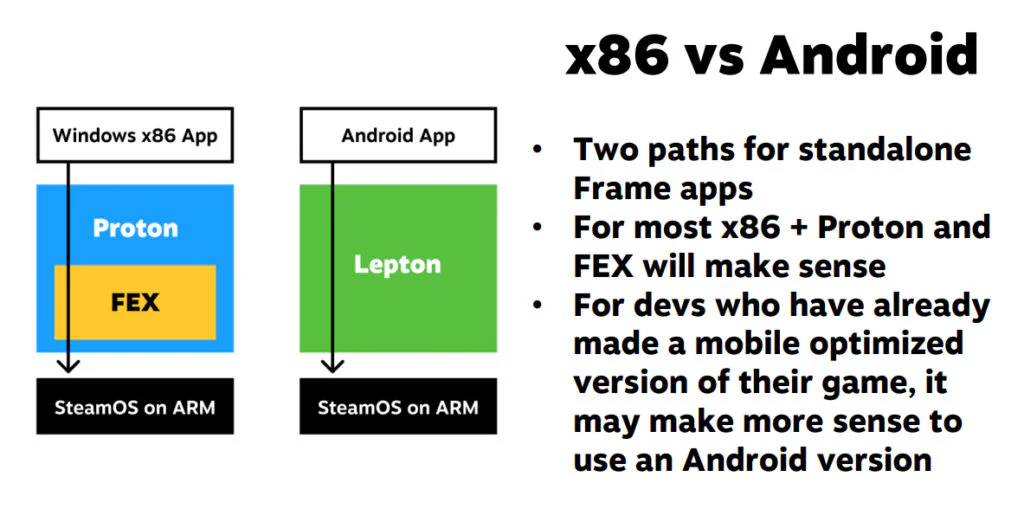
Valve also recommended that VR developers carefully evaluate their architecture approach. The Steam Frame translates Windows x86 code into Linux via Proton and then into Arm using FEX, while Android applications move directly to SteamOS through Lepton. The company noted that VR titles already optimized for Arm-based hardware, including the Meta Quest, should port to the Steam Frame with relatively little friction.
Valve had originally planned to launch the two devices, alongside a new Steam Controller in the first quarter of 2026. However, persistent memory shortages across the tech industry have forced a delay. The company still aims to ship the hardware before the end of the year, though higher RAM prices are likely to drive up the final cost.
Maybe you would like other interesting articles?