
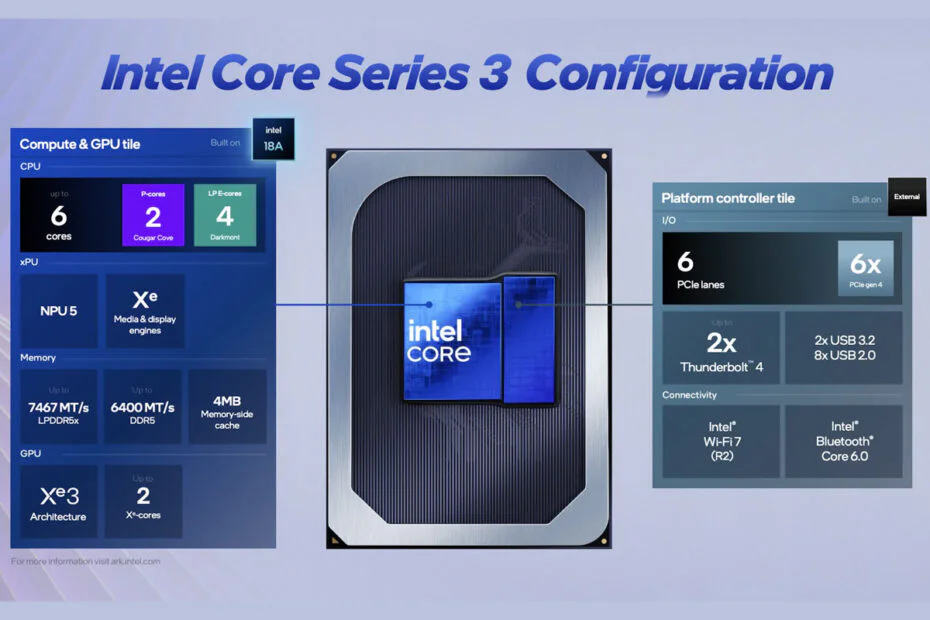
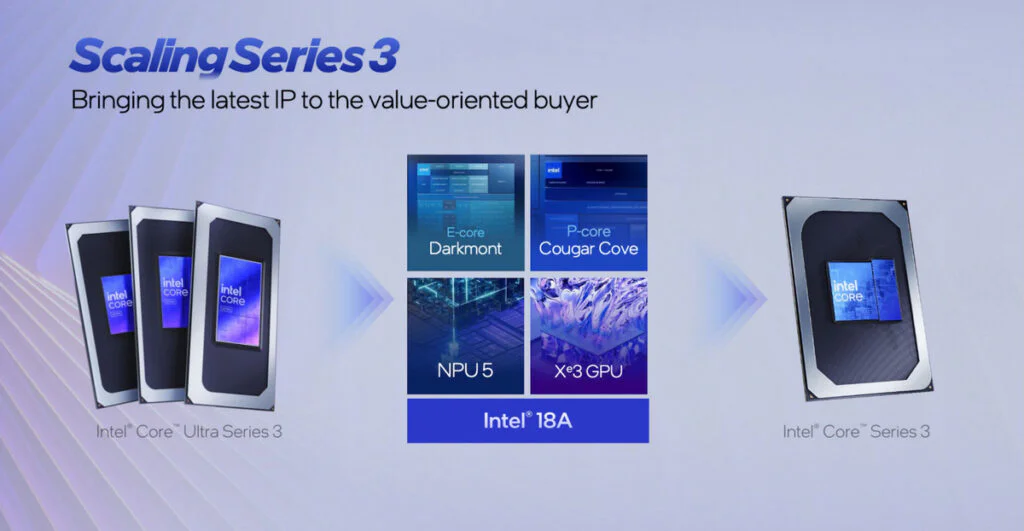
Intel is introducing its 18A process technology to more affordable notebooks with the debut of the Core Series 3 lineup, derived from the Panther Lake-based Core Ultra Series 3. These chips are designed for budget-conscious users, business systems, and basic edge computing needs.
Intel frames Core Series 3 as a refresh-cycle upgrade for SMB and home segments, targeting users moving on from five-year-old systems and legacy low-power SKUs like the Core 7 150U with measurable performance gains.
According to Intel’s internal benchmarks, performance can improve by up to 47% in single-thread tasks, 41% in multi-thread workloads, and up to 2.8× in GPU AI compared to a five-year-old PC.
Within its own lineup, Intel reports that Core Series 3 can achieve up to 2.1× faster performance in creation and productivity tasks, cut processor power use by as much as 64% during 4K YouTube streaming, and deliver up to 2.7× higher AI GPU performance compared to the previous-generation Core 7 150U, based on its reference data.
Intel describes Core Series 3 as its first hybrid, AI-ready Core Series processor, offering up to 40 TOPS of platform AI performance. This includes workloads like computer vision and speech AI, with the same silicon designed for both PCs and edge deployments.
Intel also notes support for up to two integrated Thunderbolt 4 ports, along with Wi-Fi 7 and Bluetooth 6, though availability depends on OEM configurations and regional 6 GHz Wi-Fi regulations.
Intel highlights “essential edge computing” as a key focus outside of laptops, covering applications such as robotics, smart buildings, point-of-sale terminals, and smart metering. The company says the processors balance CPU performance, built-in AI acceleration, and power efficiency, including in comparisons with Nvidia’s Jetson Orin Nano.
In Intel’s internal testing, a Core 7 350 configuration reportedly achieves up to 1.5× higher object detection performance, 1.9× faster image classification, and up to 2.2× better video analytics performance than Nvidia’s Jetson Orin Nano, based on reference workloads using YOLOv5m, MobileNet-v2, and a 1080p30 pipeline.
Intel expects more than 70 OEM designs to launch in the coming months. Early models include Acer Aspire Go 14, 15, and 16, multiple Asus Vivobook and ExpertBook systems, HP’s Omnibook 5 14, MSI’s Modern 14S and 16S, and devices from Colorful, Haier, Tecno, and Wiko.
Lenovo, Dell Technologies, and Samsung are marked as “coming soon.” Systems powered by Intel Core Series 3 will begin shipping from OEM partners on April 16, 2026, with more designs expected throughout the year, while edge platforms based on the new chips are set to arrive starting in the second quarter of 2026.
Maybe you would like other interesting articles?