
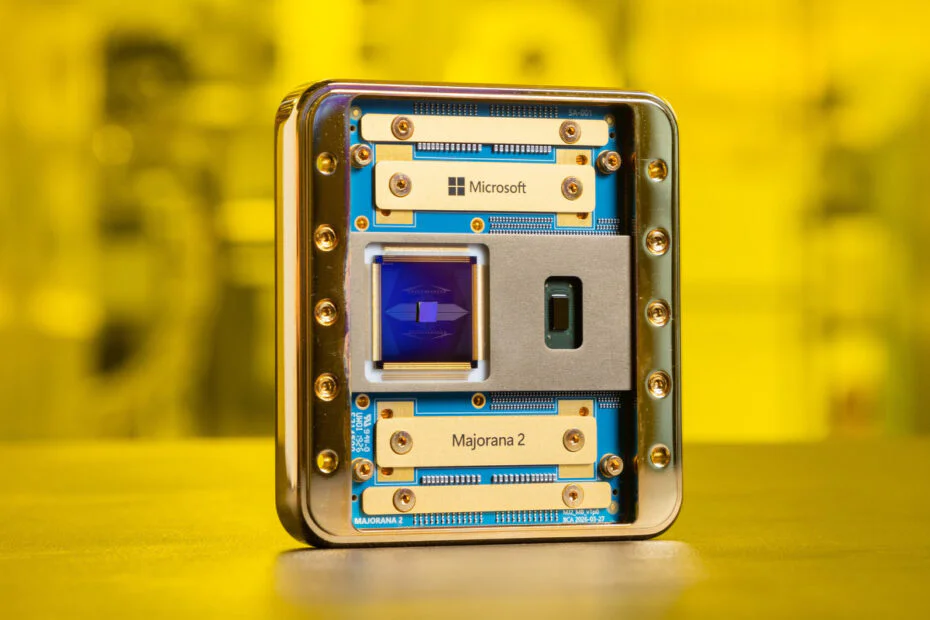
Microsoft is taking a different route in the quest for a usable quantum computer. Instead of following the same playbook as many rivals, it’s turning to advanced materials and AI to solve long-standing technical problems. The company recently introduced Majorana 2, a next-generation quantum chip that signals a shift in both its engineering methods and its approach to quantum physics.
Rather than relying on the aluminum-based superconducting designs favored across the industry, Microsoft chose lead for its latest system. The decision came with significant manufacturing obstacles, as lead has largely been avoided in chip production due to its sensitivity to water, which makes it difficult to process and handle.
“The reason why people don’t use it to build chips is it requires an incredibly specialized process to be able to go figure that out. And we figured it out,” Jason Zander, Microsoft’s executive vice president overseeing quantum efforts, told Reuters.
So far, the work seems to be showing promise in the lab. Microsoft says the qubits in Majorana 2 stay stable about 1,000 times longer than the ones in its earlier chip. Instead of lasting only microseconds, many can hold their state for around 20 seconds, and some have stretched to nearly a minute. The chip still operates at microsecond speeds, and each qubit is only about one-hundredth of a millimeter across.
AI-assisted materials research was central to the development of the lead-based platform. According to Microsoft, its proprietary agentic AI tools streamlined the discovery and evaluation of candidate materials, allowing researchers to optimize a stack engineered for greater qubit stability.
Improvements in qubit reliability and footprint have strengthened Microsoft’s outlook for scaling the technology. The company is now aiming to deliver a commercially useful quantum platform by 2029, roughly matching the projected timelines of competitors such as IBM. The race remains crowded, with Alphabet, Amazon, and several Chinese research initiatives advancing alternative architectures in pursuit of the same milestone.
Despite the progress, Microsoft’s approach continues to face scrutiny. The company’s design centers on Majorana quasiparticles, a complex state of matter that has proven challenging to confirm experimentally. Microsoft maintains that it has observed these particles, though some researchers remain unconvinced due to limited publicly available data and outstanding concerns related to earlier research.
“Microsoft can use as much lead as they like – it is not going to shield them from the basic scientific principle that your results need to be reproducible,” said Henry Legg, a lecturer in quantum physics at the University of St. Andrews.
The company has pushed back, saying it has shared detailed findings with select government partners, including the US Defense Advanced Research Projects Agency, even if not all data can be released publicly. “We’ve done enough of the physics to really have great data,” Zander said. “Believe me, I would not spend the money on the engineering if I felt like we were still off on the physics.”
For Microsoft, the emphasis now is on steady, measurable gains rather than a single breakthrough moment.
“We need to make improvements each year that will get us closer to delivering a computer that we believe will have massive commercial and societal value,” said Chetan Nayak, a Microsoft technical fellow. “We’ve got to keep marching to that roadmap to accomplish that, but where are we relative to last year? We’re 1,000 times better.”
Maybe you would like other interesting articles?