
The AI PC market has been dominated by Intel, AMD, and Qualcomm, all of which use a similar design that combines a CPU with a neural processing unit. Samsung is now preparing a different solution with its GAIA AI accelerator, which focuses on memory architecture. Early prototypes have reportedly been provided to two leading PC manufacturers.
Multiple South Korean media outlets, including Chosun, report that Samsung’s LSI division is developing GAIA as a dedicated AI processor for PCs. Early samples have reportedly been sent to HP in the United States and Lenovo in China for performance testing. If development stays on schedule, mass production could begin in 2027, with the first GAIA-powered systems expected by late 2027 or early 2028.
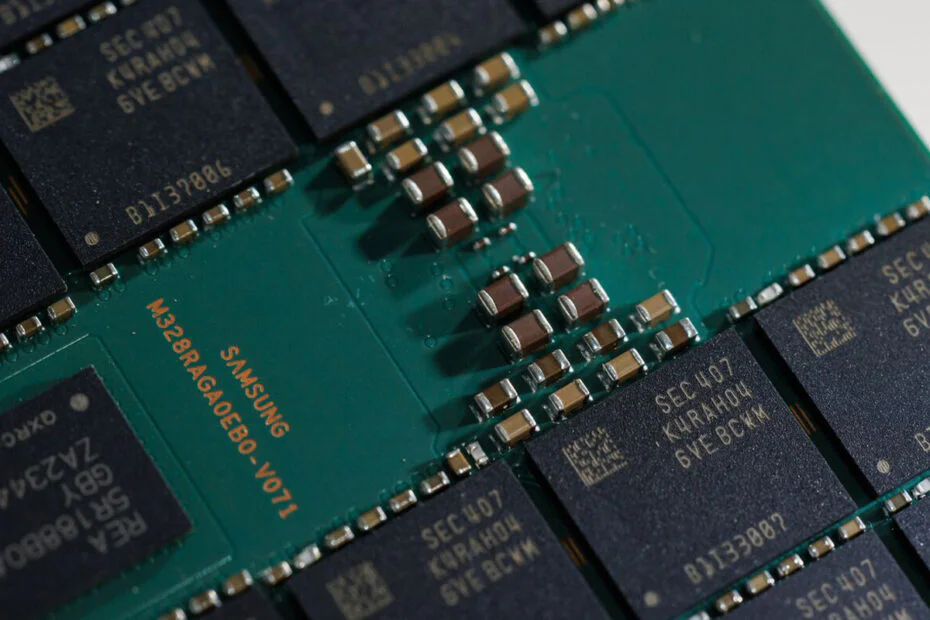
Unlike processors such as AMD Ryzen, Intel Core, or Qualcomm Snapdragon X, GAIA is not intended to power an entire PC on its own. Instead, it serves as a companion AI chip built on a 4nm-class manufacturing process with a memory-focused design. Rather than sending data back and forth to a separate processor, GAIA performs AI computations closer to memory. Samsung is positioning it as an alternative to GPU-based AI accelerators, targeting on-device generative AI tasks such as running local language models, live translation, and image generation.
GAIA’s memory-focused architecture builds on Samsung’s years of research into processing-in-memory (PIM) technology, which performs calculations directly inside memory instead of constantly transferring data to a processor. Although Samsung has explored PIM for years, the technology struggled to gain commercial momentum as increasingly powerful GPUs and mature software platforms reduced its original advantage. A dedicated NPU designed for PCs could provide a better fit, particularly because Samsung can combine its own AI hardware with in-house DRAM production.
If PC makers give GAIA the green light, Samsung could be back in the PC chip business after more than 10 years. The company tried using Exynos processors in Chromebooks starting in 2012, but that experiment only lasted a couple of years. Since then, Galaxy Book laptops have relied on Intel or Qualcomm chips, including the Snapdragon X2 Elite in the newest models. GAIA could change that by bringing Samsung-designed silicon back into its own laptops and maybe even into systems from other companies.
Samsung’s push into AI PC silicon could also create new challenges for its semiconductor business. The company manufactures chips for customers such as Nvidia and Qualcomm, both of which have interests in the AI computing market. Competing against some of those same customers while continuing to produce chips for them could make those business relationships more complicated.
The project is also intended to support Samsung’s LSI division, which has faced ongoing financial challenges in recent years. A successful AI chip business would add to the company’s Exynos and automotive semiconductor portfolio, giving the division another opportunity for growth.
Maybe you’d like some other interesting articles?