
Simulated benchmarks indicate that ASRock’s patent-pending memory design may reduce costs without significantly affecting gaming frame rates. As PC component prices rise amid an AI-driven supply crunch, the company has introduced a budget-focused memory technology known as HUDIMM. Although not yet commercially available, early results suggest the lower-cost DRAM delivers comparable gaming performance.
The HUDIMM modules, possibly meaning “Half UDIMM,” are expected to provide reduced memory bandwidth and I/O performance compared to conventional memory. Despite this, early tests indicate that gaming frame rates may remain largely unaffected.
YouTuber Bryan B. ran a series of benchmarks using a simulated HUDIMM DDR5 module, finding that it could hold its own against two standard DDR5 UDIMM sticks. The testing covered multiple game titles and CPU platforms.
ASRock’s patent-pending HUDIMM design seeks to reduce the number of integrated circuits found in standard DDR5 modules by half. Conventional DDR5 memory relies on a dual 32-bit sub-channel architecture to maximize capacity and bandwidth, while HUDIMM instead uses a single 32-bit sub-channel for data transfer.
ASRock expects its HUDIMM DDR5 modules to cost less than standard UDIMM options. The technology could help ease the impact of ongoing semiconductor supply constraints that have increased prices across the industry. For OEMs and budget-focused users with lighter performance needs, HUDIMM may help reduce overall system costs.
In a recent video, Bryan B. tested several methods to approximate how HUDIMM modules could perform, based on the assumption that they would deliver roughly half the memory bandwidth of a standard UDIMM.
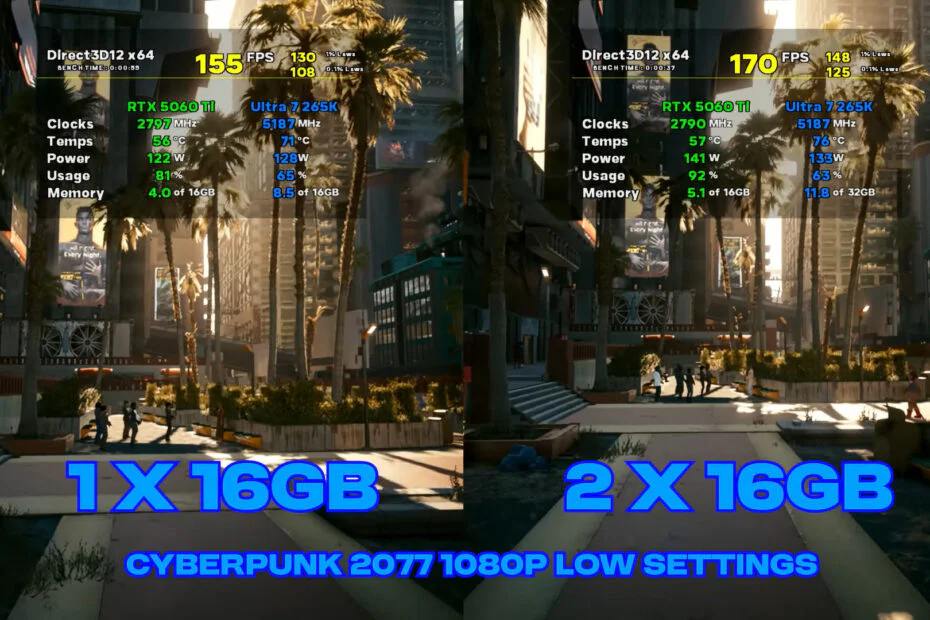
Bryan B. compared one 16GB DDR5 UDIMM module to a 2×16GB dual-channel configuration. The simulated HUDIMM performance was evaluated against the dual-channel setup using the AMD Ryzen 7 9800X3D and Intel Core Ultra 7 265K processors.
The findings suggest HUDIMM could be a viable option for lower-cost gaming systems. In titles such as Cyberpunk 2077, Counter-Strike 2, and Marvel Rivals, performance differences between 1×16GB and 2×16GB setups at 1080p were minimal. This indicates that modern x86 CPUs may not strictly depend on dual UDIMM DDR5 configurations for strong gaming results.
The simulated HUDIMM results should be viewed with caution. Actual hardware is not yet available for validation and may perform differently from standard DDR5 UDIMM configurations. In addition, Bryan B.’s testing covered a relatively small selection of games, meaning results could vary across a wider range of titles.
Maybe you would like other interesting articles?