
AMD is moving to broaden access to local AI development by embedding a one-click installer for generative AI tools directly into its graphics drivers. The company says the feature will arrive with its next Adrenalin software update on January 21, simplifying the process of running AI models on everyday consumer hardware.
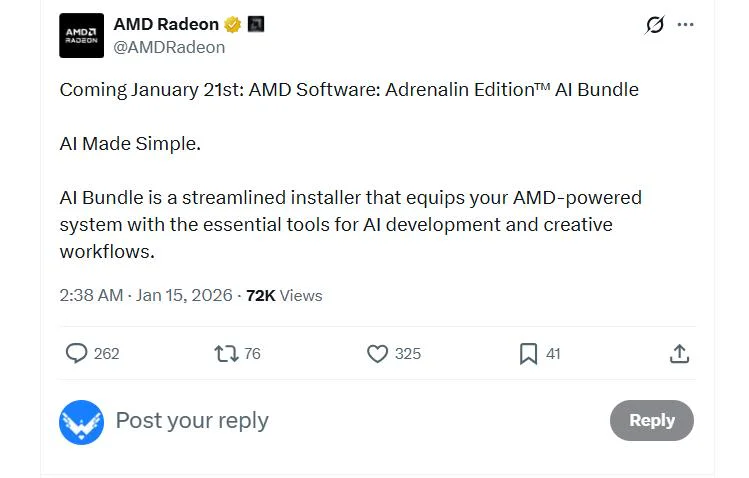
Following its wider AI push at CES last week, AMD says the update will include an optional “AI bundle” inside the driver package. The company hasn’t shared exactly what software will be included yet, but the idea is to roll several local AI tools into a single installer. That should make it easier to use things like image generators and local language models, while also improving PyTorch support on Windows.
The software push also lines up neatly with AMD’s newest chips. The installer is meant to take advantage of the AI capabilities built into the integrated GPUs and NPUs found in the expanded Ryzen AI lineup. At CES, AMD showed off the Ryzen AI 400 series, a seven-chip family based on Zen 5 CPUs and RDNA 3.5 graphics.
At the top of the lineup is the Ryzen AI 9 HX 475, a 12-core, 24-thread chip with 16 GPU compute units, boost clocks up to 5.2 GHz, and 36 MB of cache. AMD claims it can reach 60 TOPs of AI performance. Laptops using the new APUs should start showing up from several vendors this quarter, while desktop models are expected in Q2 2026.
AMD is also giving developers more to work with by rolling out an update to its ROCm software stack. Version 7.2 adds support for installation through the widely used ComfyUI framework, improves compatibility on both Windows and Linux, and makes it easier to access newer PyTorch builds on Windows for Ryzen AI systems.
AMD also had something for enterprise users, introducing Ryzen AI Halo, a mini workstation built to run massive AI models locally without needing the cloud. The system, which looks a lot like Nvidia’s DGX Spark, uses Ryzen AI Max+ processors and can be equipped with up to 128 GB of unified memory and up to 60 teraflops of RDNA 3.5 GPU power.
These updates arrive amid ongoing debate about whether the AI investment surge is sustainable. At CES, AMD CEO Lisa Su addressed the skepticism head-on, dismissing concerns about an industry bubble and forecasting rapid consumer uptake of AI technology.
Maybe you would like other interesting articles?