
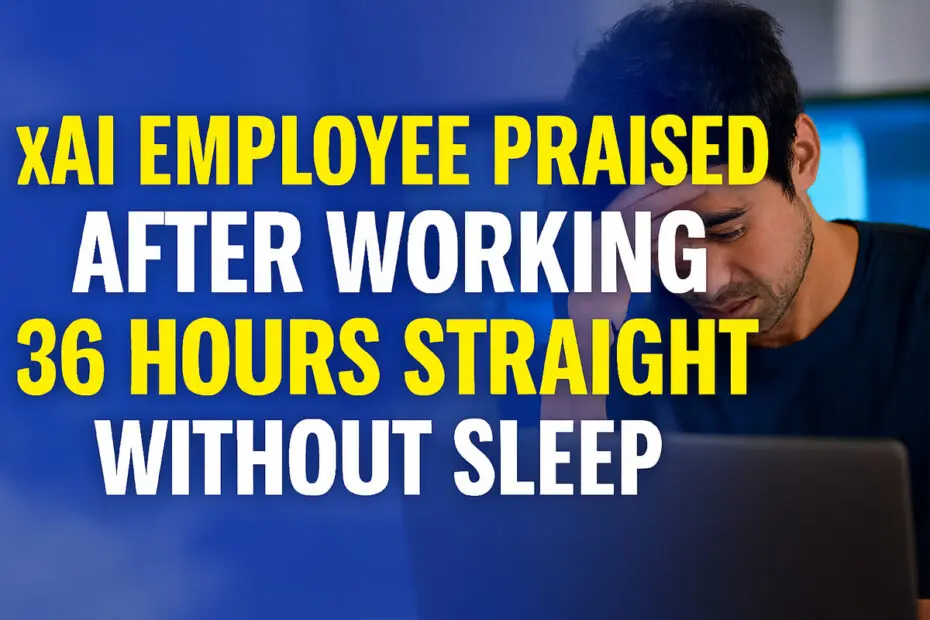
A post from an xAI engineer celebrating a 36-hour nonstop work session has reignited long-running conversations around extreme productivity expectations and the normalization of burnout in high-performance tech environments.
Parsa Tajik, an employee at Elon Musk’s startup xAI, posted on X this week saying he had just left the office after working for roughly 36 hours straight. “Although I was dead, I was also super energized. Incredibly grateful to be part of this team. Happy Thanksgiving!” he wrote.
The post quickly attracted supportive reactions, many from colleagues at xAI. One of them, Ayush Jaiswal, replied with a tongue-in-cheek comment: “Work-life balance is great, in-fact we recommend it to all our competitors. Don’t be angry with this post. You’re free to disagree and let us cook :).”
Musk himself responded, offering nothing more than a 😂 emoji, a minimalist reaction that still reads as validation given his high profile and visibility within the company.
Musk is well-known for valuing extreme dedication to work. During the Model 3 production challenges, he slept on the Tesla factory floor, and after acquiring Twitter, now X, he required staff to commit to “long hours at high intensity” or leave. The decision led to a wave of resignations and at least one legal payout of $600,000 to a former executive.
Musk’s pushback against remote work has been a consistent stance. He often positions on-site, high-intensity work as a requirement for achieving significant technical progress.
In a follow-up post, Tajik positioned his long work hours as part of a personal journey from hardship to opportunity. He wrote that working this intensely helped him go “from almost being homeless in 2020 to joining xAI,” presenting the effort as intentional and tied to his success.
The response wasn’t universally positive. Many outside Musk’s community criticized the idea, noting the difference between voluntarily working long hours and promoting a culture where overwork and potential health risks are seen as standard.
Research shows that extreme work hours often produce diminishing returns. In one study, highly productive office workers took substantial breaks, nearly 2.5 hours in an average eight-hour day. Chronic overwork and lack of sleep have been associated with reduced cognitive performance, health risks, and lower overall productivity.
“Sacrificing your health and sanity for someone who would replace you in a heartbeat is not a flex,” one user replied, capturing a common sentiment opposing the glorification of overwork.
Musk’s stance echoes similar views from other leaders. Infosys co-founder Narayana Murthy recently restated his belief that workers should put in about 70 hours per week, later increasing that figure to 72. He has also referenced China’s former “996” schedule as an approach that contributed to economic progress.
What makes this even more ironic is that Musk routinely warns about falling birth rates and says he’s “done his part,” pointing to his 11 kids. Meanwhile, experts say one of the biggest reasons people aren’t having families is the exact kind of pressure-filled work culture being encouraged.
In the end, the moment at xAI revealed a deeper conflict. One side sees long hours as proof of commitment; the other sees a warning sign. And in the scrolling commentary below the post, one brief response captured the tension perfectly: “hustle vs. health.”
Maybe you would like other interesting articles?