
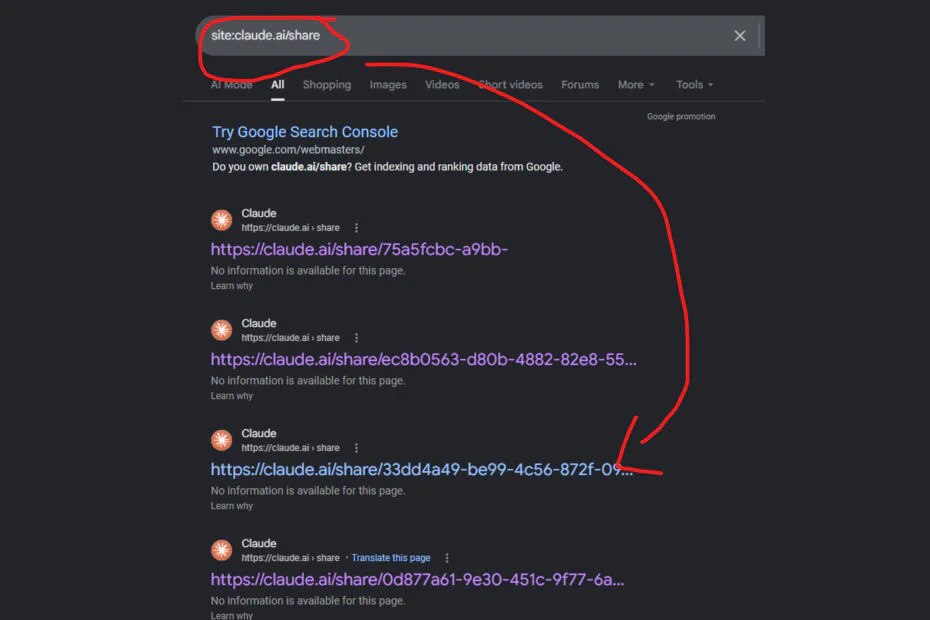
Hundreds of conversations shared through Anthropic’s Claude AI assistant were indexed by Google, exposing resumes, workplace documents, health-related discussions, and what appeared to be private chat transcripts. The incident underscores how AI conversations can become publicly accessible when shared links are indexed by search engines.
People on Reddit were the first to spot the problem, showing others how to find the chats through Google Search. More than 200 conversations showed up across multiple pages of results, including some that were only recently created. Even though the links have since disappeared from search results, many of the chats had already been copied and passed around.
The issue was caused by Claude’s sharing feature, which lets users create a public link to a conversation. Those links could be opened without a login, making them eligible for search engine indexing. Although Claude informs users that “anyone with the link” can view the conversation, it does not specifically explain that search engines may crawl and index the page unless indexing is restricted.
According to Anthropic, the exposure was tied to user actions rather than a technical failure. A company spokesperson said users are responsible for creating and sharing conversation links, which are not intended to be accessible unless someone distributes them.
In a statement to The Guardian, the spokesperson said that users who share a conversation make it publicly accessible, allowing third-party archiving services to capture it just like other public web content. She also said the links can’t be discovered unless users choose to share them.
After the conversations were discovered in search results, Anthropic updated its settings to prevent search engines from indexing shared Claude links. The company also used standard webmaster tools to remove existing entries from Google, Bing, Brave, and DuckDuckGo.
Google said it does not decide which webpages are made public, adding that website owners have tools to control whether their content is crawled or indexed. According to the company’s statement, Anthropic enabled those protections after the incident became widely known.
The Claude incident follows similar cases involving other AI platforms. OpenAI experienced a comparable issue with shared ChatGPT conversations last year, and X’s Grok chatbot also had publicly shared chats appear in search results.
The case shows how quickly a private chat can end up in public view. Once a public link is created, the content may be indexed by search engines, cached, and redistributed across the web.
Maybe you’d like some other interesting articles?