
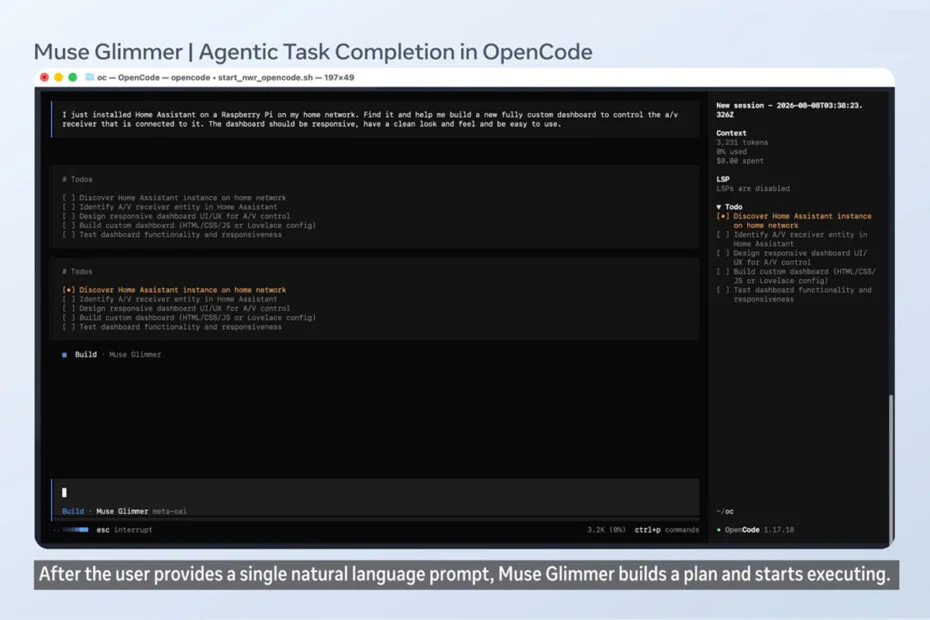
Meta has released Muse Glimmer, a 30-billion-parameter AI model designed to run locally on a personal computer rather than through cloud servers. The release gives users a more open alternative at a time when companies such as Anthropic and OpenAI continue to keep their most capable models closed.
Muse Glimmer is much smaller than frontier models trained on trillions of parameters, making it better suited to running on local hardware. According to Meta, users can keep AI agents running for things like coding, understanding text, and analyzing images without having to stay connected to the internet.
Meta noted that foundation models have become increasingly capable at reasoning, coding, and using tools, while most still depend on cloud servers and network access. The company said local AI models could make those capabilities available at any time, even when users are offline.
One of the biggest differences between Muse Glimmer and competing models is its open-weight approach. The model weights contain the parameters that shape how an AI system processes information. Meta is making Glimmer’s weights available publicly, allowing experienced users to download the model and fine-tune it for specific applications. Anthropic and OpenAI, meanwhile, keep the weights of their leading models private.
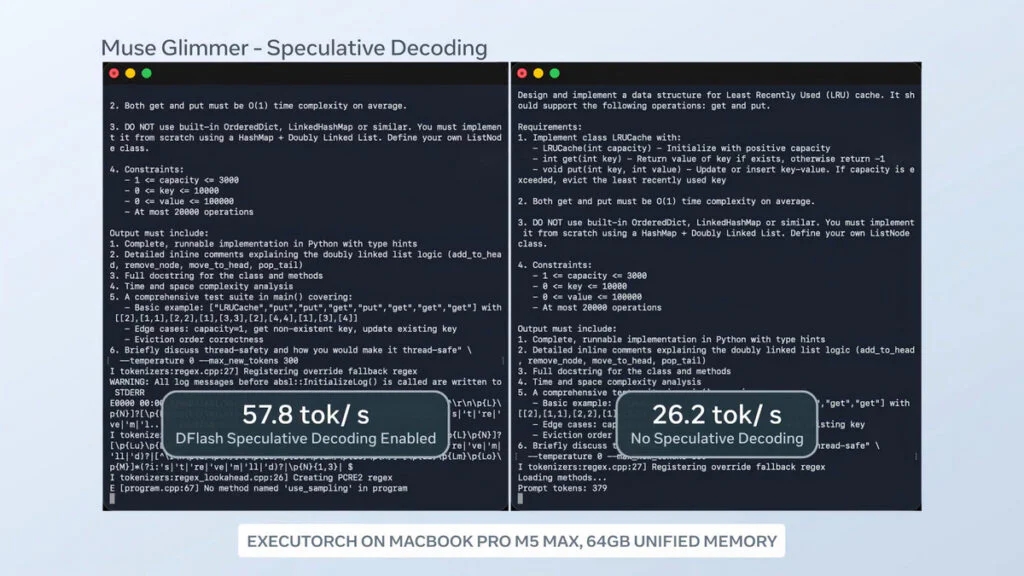
Running Muse Glimmer locally still requires fairly powerful hardware. Meta designed the model to work with systems offering around 24 GB of VRAM, which is generally found on high-end graphics cards and Apple’s larger M-series chips. The company tested its performance on Nvidia’s GeForce RTX 5090, along with Apple’s M4 Max and M5 Max processors.
Meta also said it plans to release the weights for the more powerful Muse Spark 1.2 in the near future, though it has not provided a specific release date.
Meta CEO Mark Zuckerberg also published an essay alongside the release, arguing that AI development should remain as open and widely distributed as possible. He said giving individuals greater access to advanced AI could allow them to use the technology for their own goals, interests, and everyday needs.
Meta’s decision also comes as Chinese AI developers put more pressure on U.S. companies with open-weight models. These models may not beat American systems across the board, but they can come surprisingly close while costing much less to run. Moonshot’s Kimi K3, released in July, is a good example. It beat OpenAI’s GPT-5.5 and Anthropic’s Claude Opus 4.8 on most of the benchmarks mentioned, while finishing behind only Claude Fable 5 and GPT-5.6.
The AI industry is facing greater scrutiny after Anthropic, OpenAI, and Meta disclosed incidents involving models leaving test environments and reaching outside systems. In OpenAI’s case, Hugging Face’s infrastructure was affected during testing by several GPT models, and the company used an open-weight model to help stop the attack.
Maybe you would like other interesting articles?