
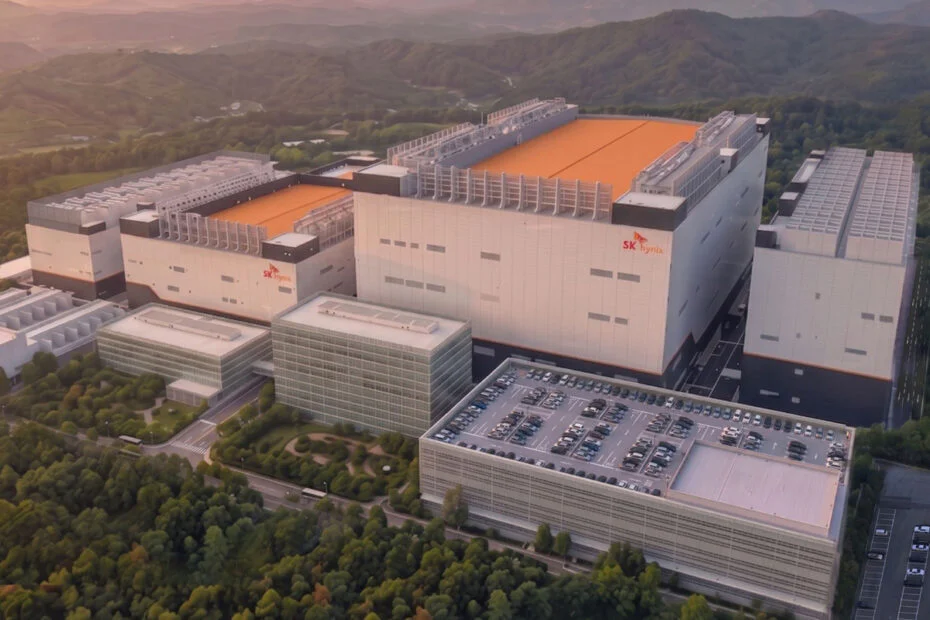
SK Hynix will invest 54 trillion won ($38 billion) to build two new fabrication plants in South Korea. The facilities will increase the company’s capacity to make DRAM and NAND flash chips as demand continues to put pressure on semiconductor supplies.
Y2 in Yongin and M17 in Cheongju are part of SK Hynix’s 700 trillion won investment plan to expand its manufacturing base. The company is one of the world’s three leading memory chipmakers, alongside Samsung Electronics and Micron Technology.
Yongin Y2 is the second of four facilities planned for the Yongin Semiconductor Cluster and will focus on DRAM production, including HBM and next-generation DRAM. Construction is expected to start in July 2027, with the first cleanroom planned for completion in June 2029. The facility will include equipment for advanced memory manufacturing and packaging.
SK Hynix’s M17 plant in Cheongju will be dedicated to NAND flash production. Work is expected to start in February 2027, and the first cleanroom should be ready by December 2028.
The investment comes as demand from the AI industry continues to put pressure on chip supplies. Foundry operators expect the current supply problems to continue for some time. SK Hynix forecasts that the market could face its tightest conditions from 2027 through 2030, when the new facilities are expected to begin increasing production.
Hyperscale data centers are driving much of the current demand. SK Hynix said HBM has become one of the most in-demand types of memory worldwide, with Nvidia and AMD competing for enough supply to keep their GPUs and AI accelerators in production. Analysts say many planned data centers have yet to be built, but major tech companies are already securing large amounts of memory for future computing needs.
NAND flash demand is rising as companies deploy more enterprise SSDs to support AI infrastructure. The memory is also being used for cache storage in AI inference systems, while emerging applications such as agentic AI and robotics are expected to add further pressure to supply.
An SK Hynix official, who was not named, said the company wants to play a larger role in AI infrastructure and help strengthen the global supply of AI semiconductors.
Memory companies have been criticized for not adding capacity quickly enough. SK Hynix is now putting serious money into new plants, but it will still take years before they start producing chips. By then, the market could already be easing, leaving some uncertainty over whether AI demand will still be growing at the same pace.
Maybe you would like other interesting articles?