
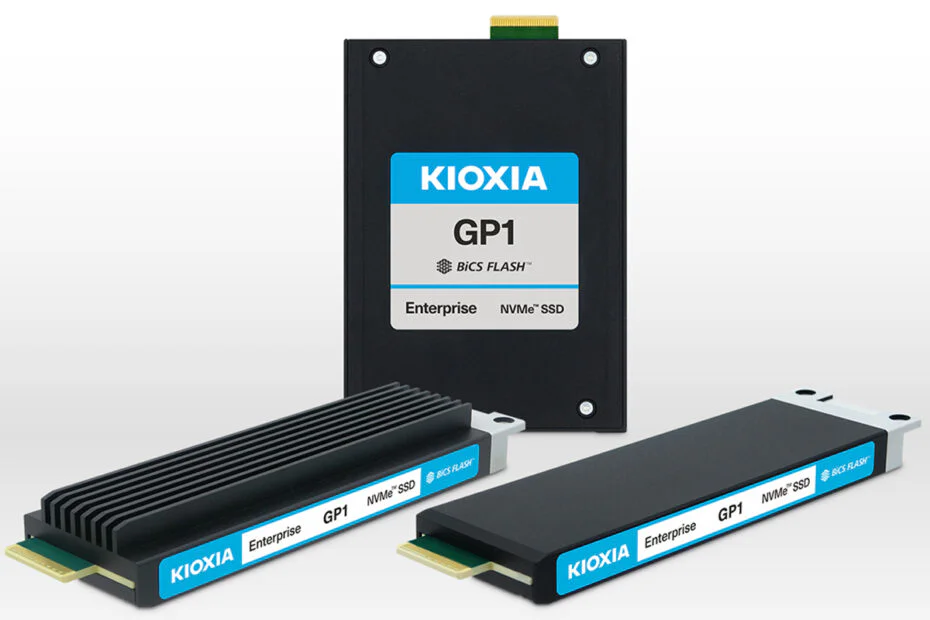
AI chips keep getting faster, but there’s still one big problem: getting data to them quickly enough. Kioxia thinks it has a smarter approach by moving NAND flash closer to the GPU, saying the design can deliver much of the needed bandwidth without the hefty price tag of high-bandwidth memory.
Kioxia’s new GP1 Series enterprise SSDs use the PCIe 6.0 interface and support the NVMe 2.2 protocol, placing them between traditional NVMe storage and the high-bandwidth memory integrated into GPUs and AI accelerators. The company says the drives can deliver large AI datasets more efficiently while reducing the need for costly HBM upgrades in data centers.
The real difference comes from Kioxia’s second-generation XL-FLASH memory. Instead of relying on the TLC NAND found in most consumer SSDs, it uses storage-class memory built for handling huge numbers of small data requests. That gives the GP1 a rating of 10 million IOPS, and Kioxia says later versions could eventually hit 100 million.
Instead of making AI chips wait for data, the GP1 SSDs let GPUs read it directly from flash through PCIe. That means accelerators can tap into far more data than would normally fit inside expensive HBM.
According to Neville Ichhaporia, who leads Kioxia America’s SSD division, XL-FLASH is fast enough and responsive enough to work as an extra layer of memory for server GPUs. He also pointed out that it’s much cheaper per gigabyte than HBM or DRAM, something hyperscalers are likely to appreciate as AI infrastructure costs keep climbing.
Kioxia plans to offer the drives in E3.S and E1.S form factors, with 9.5mm and 15mm height options. Customers can choose between standard air cooling and cold-plate liquid cooling, although liquid cooling will only be available on the 9.5mm E3.S and E1.S variants. The drives are rated for up to 50 drive writes per day.
Kioxia is not alone in looking for ways to overcome memory limitations in AI systems. SanDisk and SK hynix are pursuing High Bandwidth Flash as another potential solution, while Kioxia is continuing to expand its traditional storage portfolio with products such as its previously announced 245TB LC9 enterprise SSDs.
Earlier this year, Kioxia warned that the era of $50-per-terabyte consumer SSDs has effectively come to an end. Even so, the company continues to pursue lower-cost storage with products such as the recently introduced EG7 Series, which is based on quadruple-level cell (QLC) NAND.
Maybe you would like other interesting articles?