
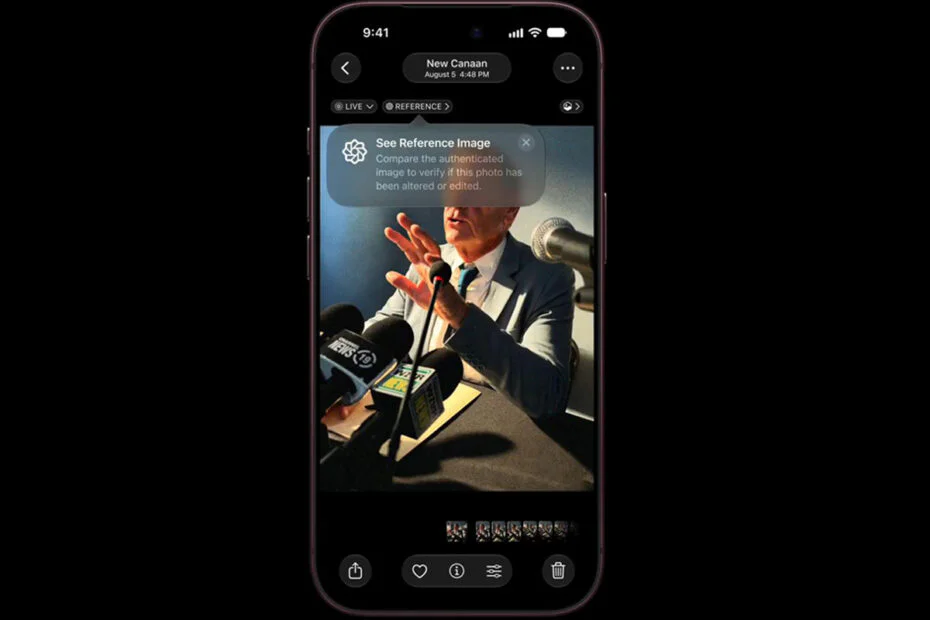
Apple’s iPhone 18 Pro and Pro Max ship with a new photo authentication tool called Apple Reference Image. When enabled, it generates a cryptographically signed reference copy at capture time, giving users a way to verify a photo hasn’t been altered.
Apple states that the system is meant to verify an image was taken by an iPhone camera sensor, rather than edited or created using AI.
With Reference Image turned on, the camera sensor switches into a separate operating mode. It signs the pixel data right after the photo is taken, before the standard software processing begins.
Apple calls this a critical distinction from rival authentication systems. Most competitors attach provenance data only after the image has already run through software processing – a gap, Apple argues, that leaves room for tampering before the signature is applied.
Apple refers to the resulting file as a “secure digital negative.” Stored locally on the device, it holds pixel data, sensor metadata, and cryptographic timestamps, and unlike a regular photo, it isn’t meant to be edited.
The Secure Enclave Processor also signs capture-related information from outside the sensor, such as exposure settings, digital zoom, and lens data. Apple says this data is kept separate from the sensor data and cannot alter the underlying pixels.
A reference image still needs to be developed into a usable photo. When a user chooses to do this, the device sends the original negative to Apple’s Private Cloud Compute system.
On Apple’s servers, Private Cloud Compute checks the sensor and Secure Enclave signatures, confirms the components trace back to the same iPhone, and verifies that the software processing the image has been approved. Only then is the photo processed into a finished JPEG.
Apple says the final image gets a composite signature combining RSA-3072 with ML-DSA-87, a post-quantum cryptographic algorithm. The company says this is meant to keep images verifiable long-term as cryptographic threats evolve.
Instead of relying on a single timestamp from the phone’s operating system, the system records a range for the capture time. The device periodically receives cryptographic time records that set a lower bound before the photo is taken and an upper bound after.
Apple said it can add the upper timestamp later if the iPhone is offline when the image is taken.
Apple also emphasized that the system is built with photographer privacy in mind. Reference Images carry no public credential identifying who took the shot, and Apple said the technology is designed to stop others from publicly tying multiple photos back to the same camera sensor.
There’s a built-in way to revoke images if fraud is detected. Private Cloud Compute assigns each Reference Image a confidence score based on whether it displays the expected traits of Apple‘s camera hardware.
If a security issue is found, Apple can invalidate a single image or revoke all images linked to a given sensor. Apple said this revocation process doesn’t require the company to view the photo’s content.
For all its complexity, Reference Image is just an option – the core camera system on the iPhone 18 Pro lineup carries on as before. There’s still the 48-megapixel Fusion main camera with its variable aperture, the 48-megapixel ultra-wide, and the 48-megapixel telephoto lens, capable of 12-megapixel 8x optical zoom.
Apple Reference Image is available only through the main camera sensor on the iPhone 18 Pro models. Also, Apple Reference Image is not available in the EU and China.
Maybe you would like other interesting articles?