
Since the late 1990s, NASA’s Mars rovers have greatly expanded our knowledge of the Red Planet. However, mobility remains a major limitation. Perseverance, the agency’s latest rover, travels at less than 0.1 mph on flat surfaces. Uneven terrain can accelerate wheel wear, while rocky and sandy slopes frequently require longer routes to safely reach scientific destinations.
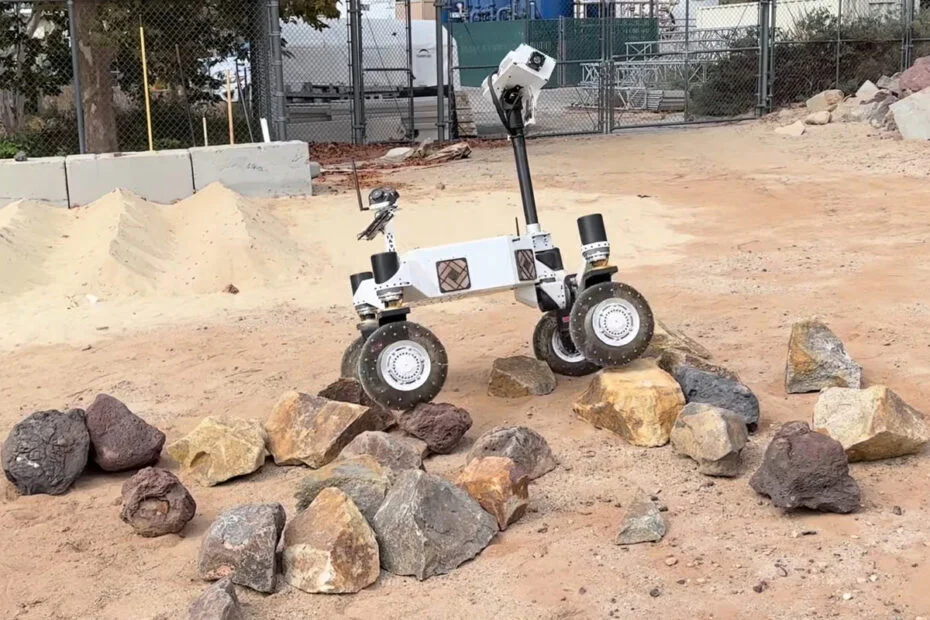
NASA may have found a way around some of the limitations that hold today’s rovers back. This week, the agency shared an update on Ernest, short for Exploration Rover for Navigating Extreme Sloped Terrain, as it underwent testing in the Colorado Desert. The prototype is designed to support future exploration missions on both Mars and the Moon.
Unlike NASA’s previous six-wheeled rovers, Ernest uses a four-wheel design. The prototype is about four feet long, and each wheel can be raised independently to navigate obstacles. A mission-ready model would be expected to be around twice as large.
During a week-long field test in the desert, Ernest accumulated more than 37 hours of driving time and traveled roughly 16 miles. The prototype reached speeds of up to 0.6 mph. According to JPL planetary scientist James Keane, the vehicle could enable extended scientific expeditions across the surface of the Moon or Mars.
Ernest’s improved mobility comes from a redesigned suspension system. NASA’s Mars rovers have traditionally used passive rocker-bogie suspensions, beginning with Sojourner, to maintain stability across rough terrain. Ernest introduces active suspension, using two powered front joints connected to a gimbal that supports multiple movement modes, including wheel-walking, squirming, and obstacle climbing. The rover can transition between active and passive suspension depending on operational needs, and its four steerable wheels provide full directional movement.
The project began in 2022, and researchers have since evaluated nearly a dozen active suspension designs through several prototype generations. The newest version also features improved autonomous capabilities, supporting the team’s broader objective of creating rovers that can travel farther and faster while requiring less input from operators on Earth.
Maybe you’d like some other interesting articles?