
Samsung is making sure it has a steady stream of orders before its chips even leave the factory. By signing long-term agreements with major data center companies, the chipmaker expects to lock up as much as 70% of its future production while securing advance payments and stable prices. According to Samsung, AI demand is still growing faster than supply, and it believes the market could stay tight well into 2028.
Ryu Young-ho, a senior analyst at NH Investment & Securities, said Samsung’s earnings call delivered a more positive message than many had anticipated. Speaking to Reuters, he described management’s comments as among the most reassuring the market has heard in quite some time.
According to Jaejune Kim, executive vice president of Samsung’s memory business, the company has signed long-term supply agreements with the five largest global data center operators and is close to completing similar contracts with five additional customers. The agreements will remain in place for at least five years and are expected to cover 60% to 70% of Samsung’s future manufacturing capacity. They also include upfront payments and minimum pricing, helping the company maintain more stable revenue while investing in advanced chip production.
The memory market is changing as large cloud and data center companies move away from short-term purchases. Many are securing long-term supply of high-bandwidth memory (HBM), a key component used in AI chips from Nvidia and AMD.
Samsung’s update comes after a volatile period for chip stocks. Investors have questioned the sustainability of AI spending and the impact of competition from China, but the company’s outlook painted a more confident picture of the market.
Samsung’s earnings show the strength of AI demand. The semiconductor division earned 89.2 trillion won ($61.7 billion) in operating profit during the second quarter, up more than 250 times from a year earlier. Total operating profit reached 89.5 trillion won, while revenue rose 130% to 171.5 trillion won.
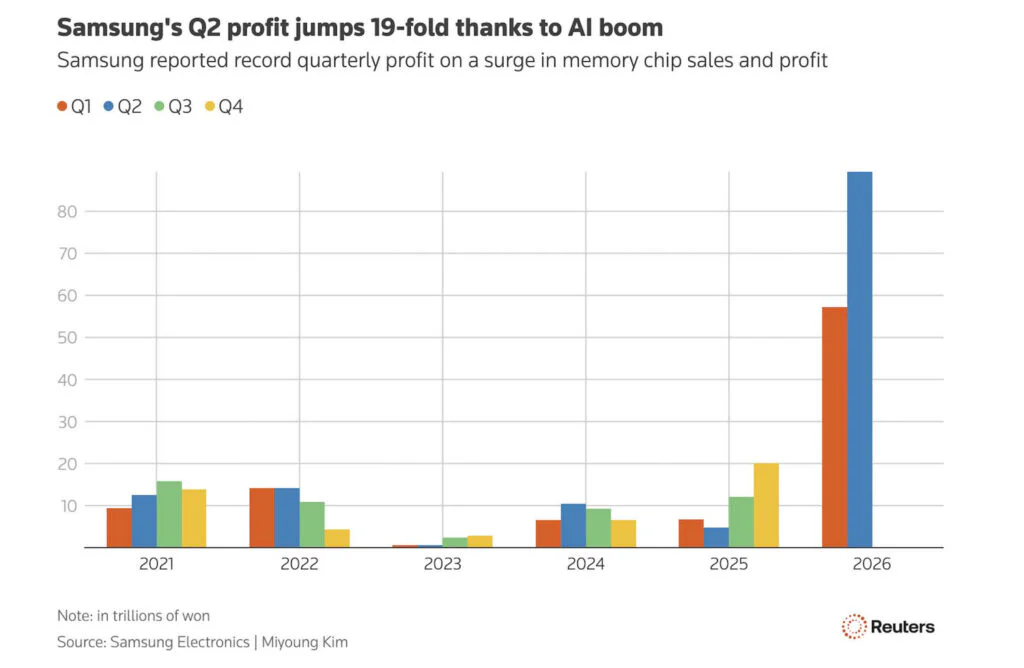
Not every part of Samsung is benefiting from the AI boom. While its chip business is thriving, the mobile division posted its first quarterly loss, coming in 700 billion won in the red. Josh Gilbert, an analyst at eToro, summed it up by saying the chip business is now boosting one side of Samsung while putting more pressure on the rest of the company, especially if memory prices or AI demand weaken.
HBM is a major focus for Samsung’s AI business. The company expects HBM4 revenue to more than triple in the third quarter. That growth could help Samsung close the gap with SK Hynix and increase its HBM market share closer to its overall DRAM share later this year.
Samsung is also expanding its manufacturing network. The company expects its foundry business to improve as factory utilization increases and pricing remains strong. Its Taylor, Texas fab is still on track to open this year, and a second facility is planned for mass production in 2030.
SK Hynix also delivered strong earnings this week and plans to increase capital spending by about 50% to meet AI demand. Samsung said it remains financially secure. CFO Park Soon-cheol said the company has no plans to issue American depositary receipts, citing steady cash flow from its existing businesses.
Maybe you’d like some other interesting articles?