
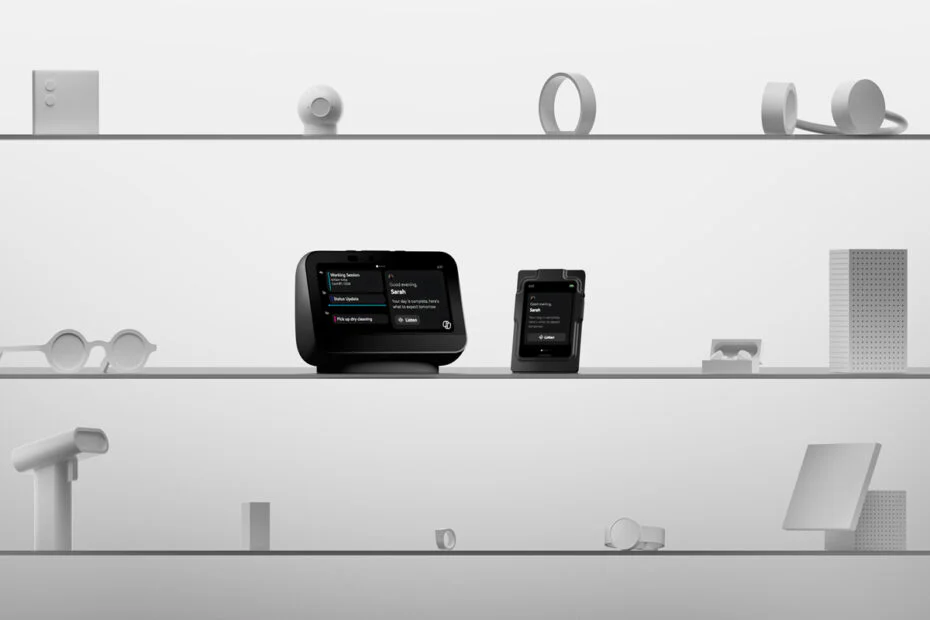
Microsoft is building a new platform named Project Solara that focuses on AI agents for both personal and workplace computing. During Build 2026, the company introduced a smart display and a smart key badge as examples of hardware designed specifically for agent-driven interactions.
Microsoft believes computing is moving toward AI agents instead of app-based experiences, and it is developing Solara as the platform for future devices designed around that shift.
The smart display reference device can pull information from Microsoft 365 services, including upcoming Outlook meetings and data stored in Excel, while also supporting voice commands. According to Microsoft’s demonstration, it could eventually handle tasks on a user’s behalf. The companion smart key badge offers many of the same capabilities in a portable form, with added features such as 5G connectivity, a touchscreen, and a camera for capturing information on the go.
Microsoft emphasized that the showcased devices are reference designs rather than commercial products. Their purpose is to demonstrate the types of experiences that agent-focused hardware could enable. While Qualcomm and MediaTek collaborated on the prototypes, Microsoft said Project Solara is intended to support a broad range of device categories and hardware configurations.
“Project Solara is specifically designed for the new era of agent-first devices,” Microsoft says. “It establishes hardware and software requirements that will meet enterprise needs for manageability, security, and privacy, while ensuring critical user experiences are delivered.”
The requirements are relatively flexible. According to Microsoft, Solara doesn’t depend on a single AI agent, allowing users to select the agent that best fits their needs. The company plans to expand that approach with an agent dispatcher and task manager that can help manage interactions automatically. Solara also supports adaptive interfaces through a system Microsoft calls “just-in-time UI,” which can resize, rearrange, or generate interface elements based on the device and context.
Although many aspects of Solara are unique to Microsoft, the platform is built on top of Android, according to GeekWire. It runs on the Microsoft Device Ecosystem Platform (MDEP), an Android-based operating system designed for enterprise hardware. That foundation is intended to simplify deployment across different device categories, a strategy that will soon be tested through pilot programs with companies such as Target Corporation, CVS Health, and Best Buy.
Maybe you would like other interesting articles?