
A long-running dispute over the taxation of digital businesses is rapidly escalating into a broader trade issue. The United States is now threatening to impose 100% tariffs on countries that apply digital services taxes to American tech firms, raising the prospect of a wider trade conflict that could extend well beyond the technology sector.
Several European countries have introduced or are considering digital services taxes targeting revenue from digital advertising, online marketplaces, and other sectors largely dominated by U.S. technology companies. On Friday, President Donald Trump responded with a blunt warning.
In a social media post, President Donald Trump said several European countries were moving closer to introducing digital services taxes targeting American companies. “Numerous European Countries have been discussing the imminent implementation of a Digital Services Tax on American Companies,” he wrote. “Some of these Countries are close to actually doing this.”
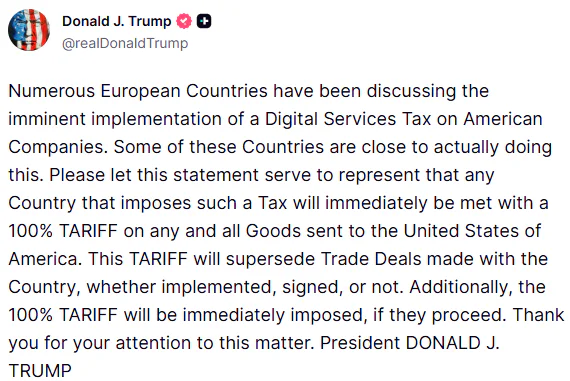
The announcement marked an escalation in the U.S. response to digital services taxes. Rather than keeping the dispute within the realm of tax policy, the administration is framing it as a trade issue, backed by the threat of significant tariffs. Trump added that the proposed penalties would apply “whether implemented, signed or not,” regardless of current trade agreements.
The move also puts fresh pressure on last year’s trade deal between the U.S. and the European Union. The agreement capped U.S. tariffs on European products at 15%, while the EU promised to scrap tariffs on American industrial goods. But the EU’s slower approval process had already created tensions, with Washington warning that tariffs, even on cars, could go up. European governments recently worked to meet Trump’s July 4 deadline, yet the disagreement over digital taxes is still unresolved and has become a major sticking point.
France has been one of the strongest supporters of digital services taxes. It introduced a 3% tax in 2019 on revenue from certain digital services, covering companies that make more than €25 million in France and €750 million worldwide. French lawmakers are now looking at doubling the tax to 6%. Before meeting President Donald Trump at the G7, President Emmanuel Macron said France had no plans to drop the tax despite pressure from Washington.
The two sides have been stuck on this issue for years. European governments say today’s digital companies can make huge profits in a country without being physically based there, so tax rules need to change. The U.S. sees it differently, arguing that these taxes mostly hit American tech companies. That view has stayed the same across different administrations. The Office of the United States Trade Representative has repeatedly warned countries, including France, Britain, Austria, and Spain, that their digital taxes could lead to retaliatory tariffs.
Trump has previously connected the digital tax dispute to specific products. Before a trip to France, he said the United States would “have no choice” but to impose 100% tariffs on French wine if the country’s digital services tax remained in effect.
Maybe you’d like some other interesting articles?