
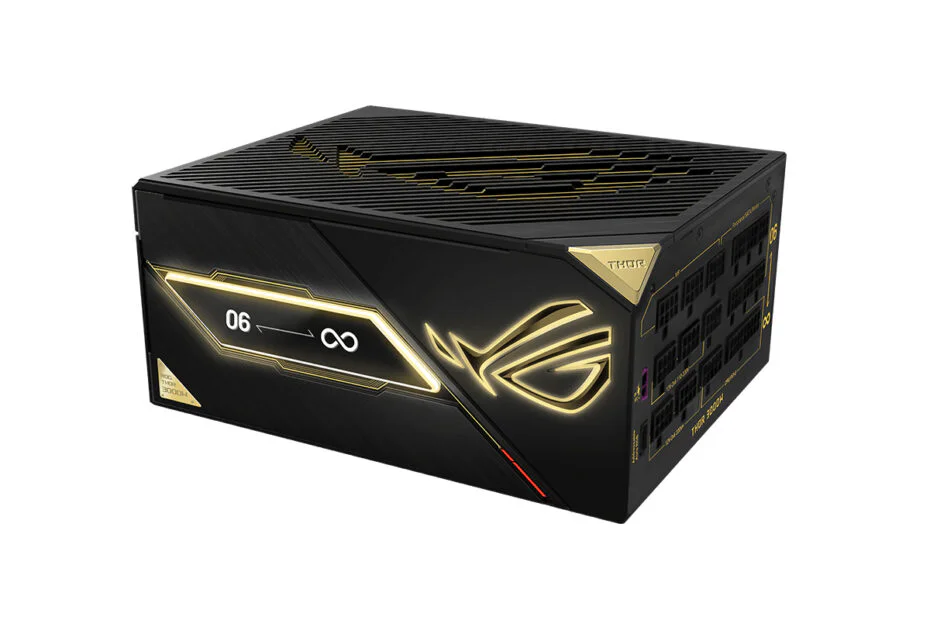
At Computex, Asus is set to showcase a range of new hardware, including monitors, unconventional caseless PC concepts, and the ROG Thor 3,000W Titanium III Edition 20.
Marketed as the flagship of the Republic of Gamers PSU lineup, the ROG Thor 3,000W Titanium III Edition 20 is designed to support highly demanding, enthusiast-grade system builds.
The spec that immediately grabs attention is Asus claiming this thing can power up to four GeForce RTX 5090 GPUs at once. ROG has always had a flair for flashy, over-the-top products, but this feels less like something built for gaming and more like hardware meant for serious rendering rigs or machine-learning setups.
The PSU is built around server-grade gallium nitride (GaN) MOSFETs, which Asus says improve efficiency, reduce wasted energy, and operate at lower temperatures than standard silicon-based designs. Power is routed through the company’s ROG Equalizer cable, a proprietary 12V-2×6 PCIe solution designed to maintain stable temperatures below the material limit of 105°C.
The PSU also comes with a GPU-First Intelligent Voltage Stabilizer intended to maintain stable voltage under heavy overclocking loads. An integrated OLED display tracks real-time power information and can be repositioned with a USB extender for improved visibility inside the system. Aura Sync ARGB lighting and several built-in protection features are also included.
The Thor 3,000W Titanium III Edition 20 features an 80 Plus Titanium efficiency rating and a dual-voltage adaptive setup. It can provide the full 3,000W in regions using 230V mains power, while output is limited to 1,600W on 115V service. Asus covers the PSU with a 10-year warranty.
This is not Asus’s first attempt at a 3,000W power supply. The company introduced another high-capacity model earlier in 2025 aimed at workstation and server environments. The Titanium III edition takes a different approach, carrying Republic of Gamers branding that feels geared more toward spectacle than necessity, especially given how few gaming systems would realistically need enough power for four flagship GPUs.
Asus has yet to reveal pricing for the PSU. Based on the hardware involved and its unusually high specifications, the cost is expected to land well above the premium range most buyers associate with high-end ATX power supplies.
Maybe you would like other interesting articles?