
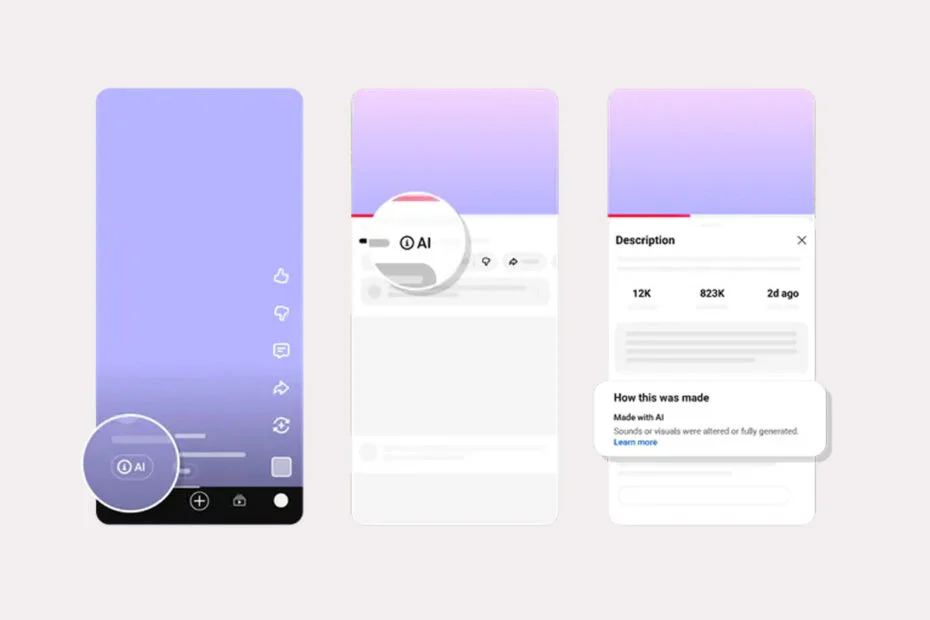
YouTube is introducing stricter rules for AI disclosures, adding more visible labels to make it clearer when videos have been heavily edited or fully created using artificial intelligence. However, the company said the update will not change how videos are recommended or monetized, a decision that may disappoint some users.
The platform, owned by Alphabet, said viewers increasingly expect clear disclosure around generative AI content and that it is streamlining how those disclosures appear across both long-form videos and Shorts.
Under the updated policy, videos that include photorealistic content significantly changed or fully created with AI must display a visible “AI” label. For standard uploads, the label appears above the description, while Shorts show it directly on the video as an overlay. The change makes disclosures more noticeable than before. Videos featuring unrealistic visuals, animation, or only minor AI edits will still carry a disclosure, though it will remain inside the expanded description rather than being prominently displayed.
YouTube is also introducing what it describes as “internal signals” to help identify AI-generated content and add labels when creators fail to disclose it themselves. The platform first required uploaders to report generative AI use in 2024 and is now adding automated checks to catch videos that go unlabeled. Creators who think a label was applied by mistake can challenge it through YouTube Studio.
Videos created with YouTube’s own AI tools, including Veo and Dream Screen, will automatically carry a permanent AI-generated label. The same rule applies to content containing valid C2PA manifest metadata, a technical standard used to verify AI-generated media.
YouTube described the update as an attempt to improve transparency without limiting creator flexibility, stressing that the new labels will not affect recommendations or monetization. Still, the decision may raise questions as AI-generated content becomes more common on the platform, especially in niche search results where synthetic videos can already overwhelm traditional uploads without any algorithmic distinction.
The update marks another step in YouTube’s expanding AI push as the platform continues to dominate online video. While Google earns billions from YouTube and rolls out increasingly aggressive ad formats, it has also been adding more AI tools for creators and drawing scrutiny for using publicly available YouTube videos to train language models and chatbot systems.
Maybe you would like other interesting articles?