
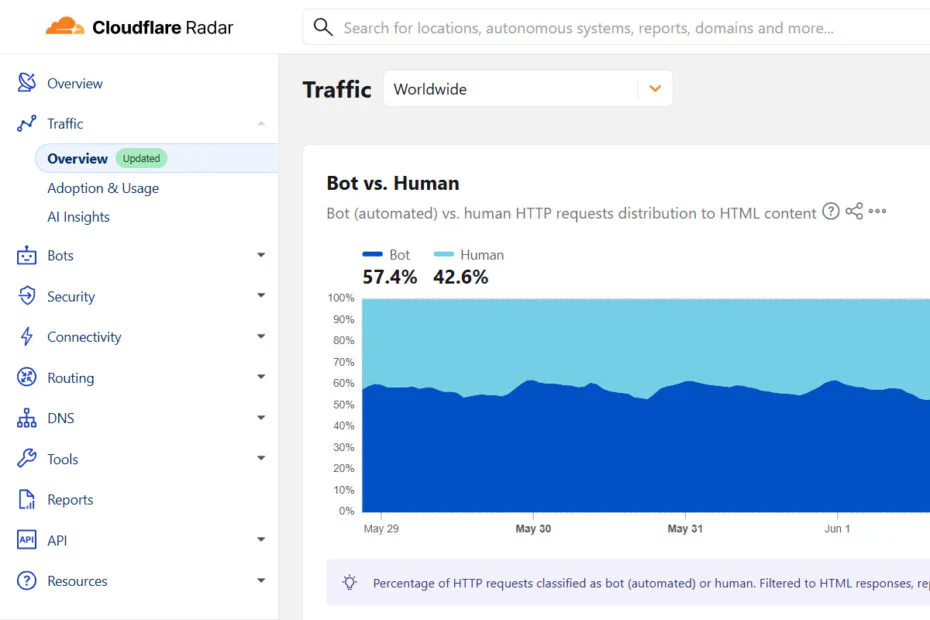
For the first time, bots are generating more internet traffic than humans, according to Cloudflare. The finding highlights how quickly AI agents have become a larger part of online activity, carrying out tasks at a scale and pace that people cannot easily match.
Cloudflare CEO and co-founder Matthew Prince said bot traffic has risen more quickly than the company anticipated. Prince had previously predicted that automated activity would surpass human traffic by late 2027, but the shift happened much sooner. Data from Cloudflare Radar now shows bots generate about 56% of all HTTP requests, with that share climbing to as much as 62% over the past week.
Driving much of the increase is what Matthew Prince describes as “agentic” traffic, AI-powered systems acting on behalf of users. Unlike traditional web crawlers or spam bots, these agents navigate websites in ways that resemble human behavior, but at a much larger scale. A task that might send a person to a handful of websites can result in thousands of automated visits when handled by an AI assistant. As more people rely on AI tools to research products, compare prices, gather information, and summarize content, bot-generated activity is becoming an increasingly dominant part of the web.
The company only started classifying newer categories of automated traffic, such as verified bots and signed agents, in the past year. As a result, long-term trend data is limited. Even so, the growth has been rapid and is beginning to reshape the economics of the web.
The rise in bot traffic is not evenly distributed around the world. Cloudflare’s data shows that some regions generate overwhelmingly automated activity. Gibraltar tops the list, with bots accounting for more than 90% of HTTP requests. Singapore and Iran also report unusually high levels, with automated traffic making up more than three-quarters of all requests. The figures do not necessarily suggest that bot operators are concentrated in those locations. Rather, they are likely influenced by factors such as data center infrastructure, network routing, VPN usage, and other technical mechanisms that affect where traffic appears to originate.
Not all bot traffic is harmful. Many automated systems perform essential functions, from indexing websites for search engines to monitoring online services and retrieving information for AI assistants. However, even legitimate bots come with costs. Their activity can increase server demand, skew traffic metrics, and put pressure on business models that depend on human engagement, advertising revenue, and subscriptions.
Publishers have been among the hardest hit by these changes. A Pew Research Center study released last year found that users were nearly 50% less likely to click on traditional search results when Google’s AI Overview appeared. At the same time, more AI-generated summaries are drawing on content created by other AI systems, with such citations now accounting for more than 10% of cases. The result is a growing disconnect between original reporting and the audiences it was intended to reach.
Cloudflare’s report has prompted fresh discussion about the “Dead Internet Theory,” which suggests that automated activity now dominates the web. However, the company’s data specifically measures HTTP requests rather than attention, engagement, or the number of users online. People still make up the majority of activity when it comes to consuming content, using social platforms, shopping, and interacting with others online.
Maybe you would like other interesting articles?