
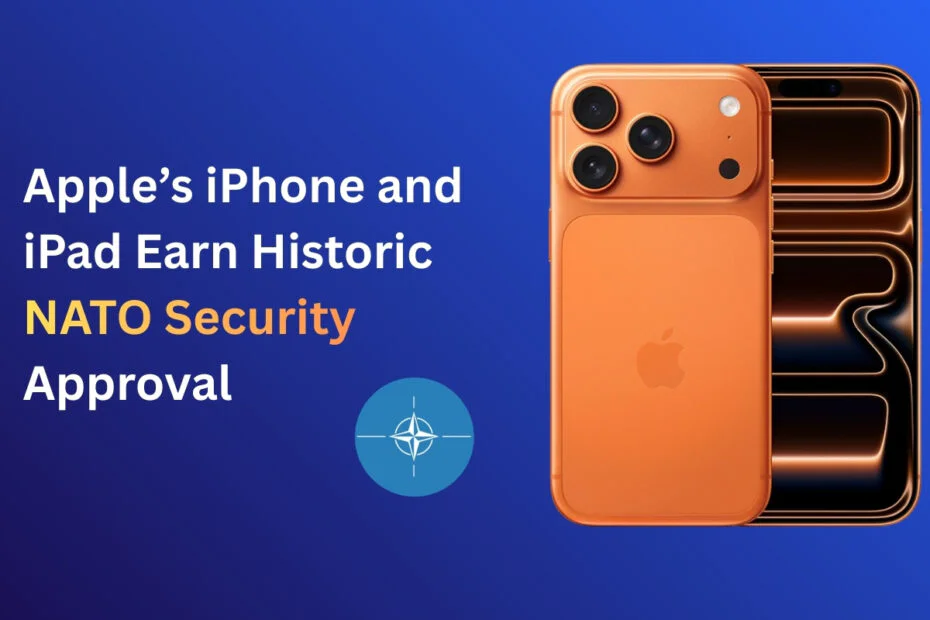
Apple’s consumer devices have been approved to handle NATO’s restricted-level classified data. German government authorities granted the certification after reviewing the company’s security measures. The approval applies to iPhones and iPads running iOS 26 and iPadOS 26 in all NATO member countries.
The certification positions Apple in a category of its own. To date, no other consumer mobile device vendor has satisfied NATO’s information assurance requirements at this level.
The evaluation found that Apple’s security architecture, including its Apple Silicon processors, Secure Enclave subsystem, and encryption-based software layer, complies with NATO requirements for handling restricted information. Apple noted that the certification doesn’t require any additional software or unique configuration changes.
The NATO Information Assurance Product Catalogue now lists iOS 26 and iPadOS 26 as eligible for secure handling of core functions such as Mail, Calendar, and Contacts.
Apple’s head of security engineering, Ivan Krstić, said the certification highlights how the company has approached secure mobile computing differently. He explained that, in the past, devices capable of processing sensitive information were mainly custom-built government systems. Apple’s consumer-focused security framework now satisfies government-grade requirements without additional changes.
At a technical level, Apple’s security framework relies on a combination of hardware and software safeguards designed to meet government encryption standards. One example is Memory Integrity Enforcement, which blocks compromised apps from modifying protected areas of memory, a key defense when handling classified workloads. Together with the Secure Enclave’s isolated cryptographic system for biometric authentication, Apple’s tightly integrated hardware and software create a controlled and resilient security environment.
The decision also points to a wider shift in how NATO countries approach mobile security. By clearing off-the-shelf Apple devices, the alliance is effectively recognizing that consumer technology can match the performance of the custom-built systems long relied upon by government agencies. The move may pave the way for broader certification programs that bring commercial hardware into military and intelligence settings.
The clearance strengthens Apple’s push to pair usability with high-level security. The company has promoted end-to-end encryption and zero-trust design in enterprise and government markets. NATO’s approval gives that claim added authority.
Maybe you would like other interesting articles?