

AMD just shared the price for the Ryzen 9 9950X3D2, and it’s definitely on the expensive side. The chip will cost $899 when it arrives on April 22, which is $200 more than the Ryzen 9 9950X3D launched for. The pricing was confirmed by David McAfee, who posted the details on X.
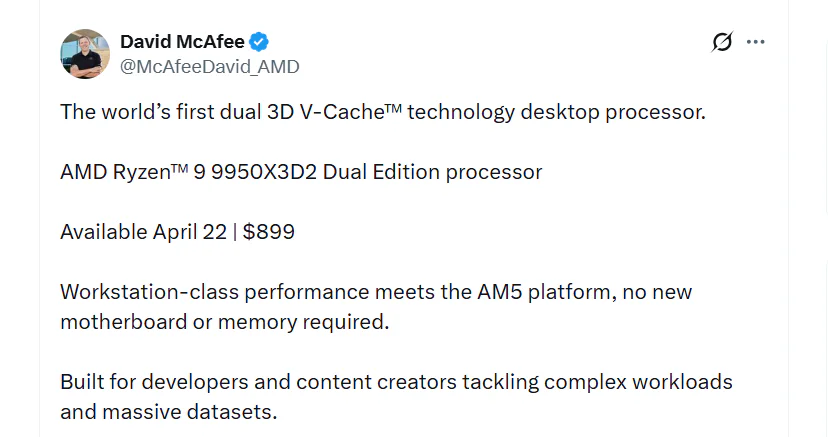
Some retailers briefly listed the Ryzen 9 9950X3D2 at around $1,000 over the weekend, which set expectations pretty high. AMD has since confirmed the real price at $899, about $100 less than those early listings. It’s still roughly $230 more than what the Ryzen 9 9950X3D sells for right now.
With the Ryzen 9 9950X3D2, AMD is debuting a dual-cache X3D architecture. Each CCD includes stacked cache, pushing total cache capacity to 208MB. AMD estimates the configuration can deliver 5% to 10% gains in select rendering and content creation scenarios over the Ryzen 9 9950X3D.
Although X3D chips are widely known for strong gaming performance, AMD is framing the Ryzen 9 9950X3D2 as a workstation-focused part. The company highlights workloads such as compiling game engines, running AI models, and 3D rendering. Notably, AMD has not shared gaming benchmarks, instead publishing tables that compare application performance against the 9950X3D.
AMD claims the processor can deliver up to 13% better performance in AI and simulation workloads. It also reports about 7% gains in V-Ray and Blender rendering, and 5% to 7% improvements in content creation benchmarks such as Puget for DaVinci Resolve and Geekbench multi-core. Gaming performance is expected to be similar to the 9950X3D.
Like its predecessor, the 9950X3D2 features 16 cores and 32 threads based on AMD’s Zen 5 architecture. However, its thermal design power rises to 200W, an increase of 30W over the previous model. The maximum boost clock is slightly lower as well, dropping to 5.6 GHz from 5.7 GHz on the 9950X3D.
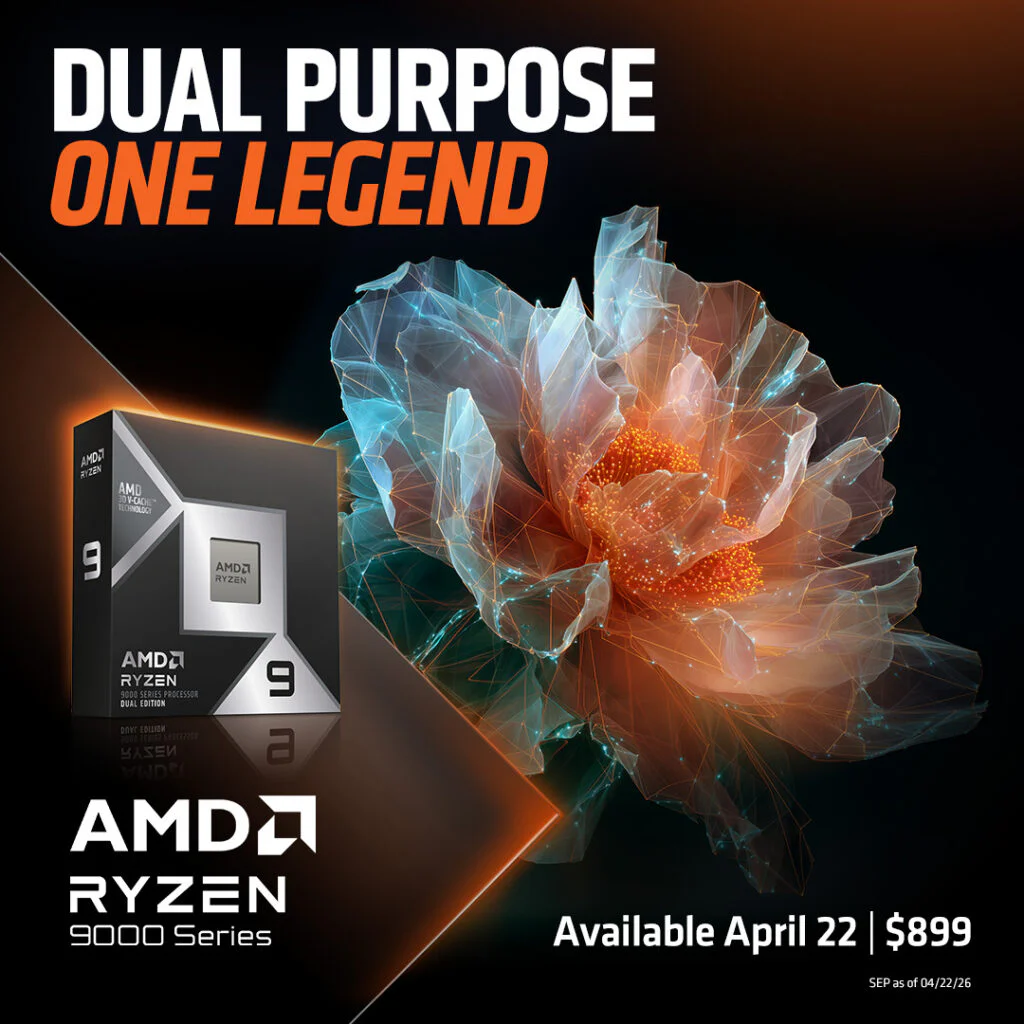
The processor remains part of the AM5 platform, retaining support for DDR5 memory, PCIe 5.0, and Precision Boost Overdrive 2. AMD is also packaging the chip in a monochrome “Dual Edition” box to differentiate it from earlier models.
Maybe you would like other interesting articles?