
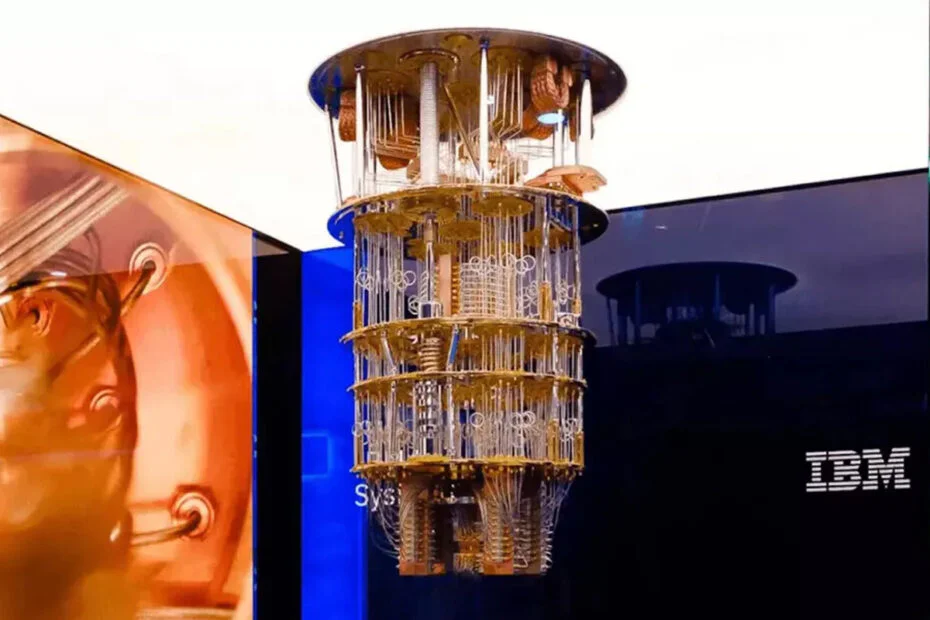
IBM is expected to receive the largest portion of the funding, securing $1 billion under the initiative. Widely viewed as a leader in quantum computing, the company has spent years developing hardware and software aimed at supporting quantum workloads. Under the agreement, IBM will also contribute another $1 billion of its own to build what it describes as the country’s first facility dedicated to manufacturing quantum chips, operated through a newly established business unit focused on production.
IBM CEO Arvind Krishna compared today’s state of quantum computing to the position AI chips occupied about a decade ago. Speaking to The Wall Street Journal, Krishna said the recent wave of deals signals growing confidence that the industry could be nearing a breakthrough within the next few years.
The funding is being distributed across multiple technical approaches instead of focusing on a single quantum architecture. Companies developing different types of quantum systems are included in the plan. GlobalFoundries will receive $375 million, with the government gaining an estimated 1% ownership stake, while the company launches a new business segment dedicated to quantum technologies.
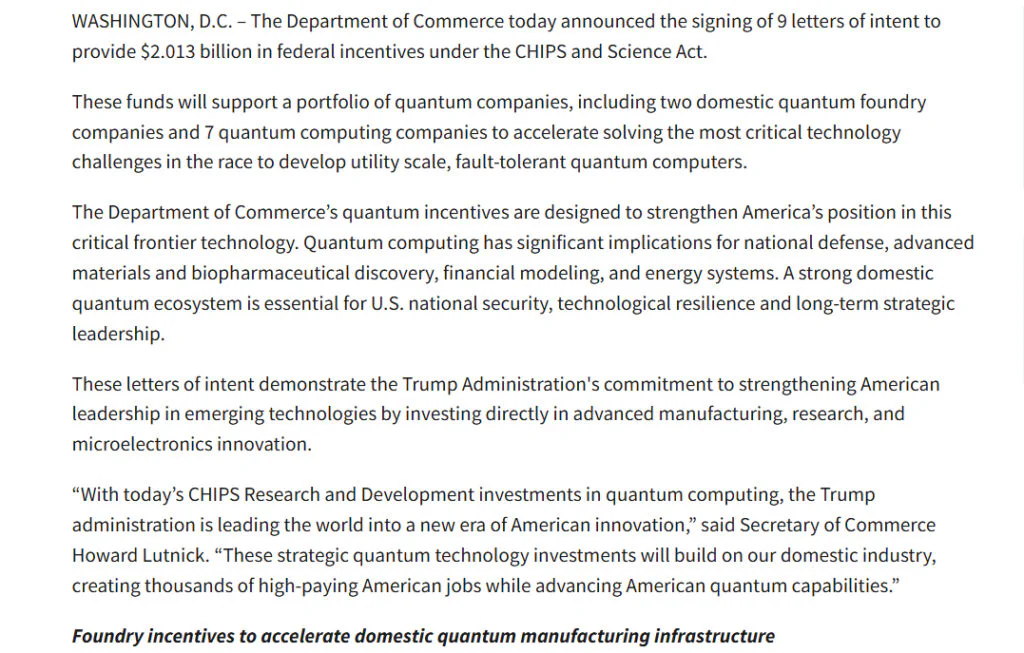
Several other companies are included in the funding program, including D-Wave Quantum, Rigetti Computing, and Infleqtion, all of which use different methods to develop quantum systems. D-Wave works on quantum annealing, Rigetti develops superconducting qubits, and Infleqtion focuses on neutral atom technology. Most recipients are expected to receive close to $100 million, while Diraq is projected to receive $38 million.
Atom Computing, PsiQuantum, and Quantinuum are also reportedly in line for funding. PsiQuantum, in particular, raised $1 billion last year from investors that included 1789 Capital, where Donald Trump Jr. is a partner.
Quantum systems exploit the behavior of subatomic particles to process information, potentially solving certain classes of problems, in molecular modeling, optimization, and cryptography, far more efficiently than classical computers. IBM’s Krishna pointed to recent protein simulations as early evidence of practical use cases in drug discovery. Yet the timelines remain uncertain. A senior Commerce Department official acknowledged the agency spread its investments across multiple deals with the understanding that returns could take years to materialize.
Not everyone is convinced the investment push will deliver on its promise. Dana Goward, president of the Resilient Navigation and Timing Foundation, said enthusiasm around quantum computing remains high because many see it as the next major technological shift, but added that many of the field’s expectations have yet to materialize. Researchers are still investigating possible applications, including systems that could eventually provide an alternative to GPS.
Executives in the quantum sector say progress is accelerating, driven by improvements in chip design, qubit performance, and error correction that are gradually reducing technical limitations. They also say increased funding is helping move development forward more quickly, particularly as specialized manufacturing capacity begins to develop.
The agreements have yet to be finalized, but the size and structure of the proposed awards suggest a government intent on staying actively involved as quantum technology develops. Whether direct federal stakes in quantum firms will ultimately deliver meaningful returns remains uncertain, though the level of investment signals that the United States is moving ahead regardless.
Maybe you would like other interesting articles?