
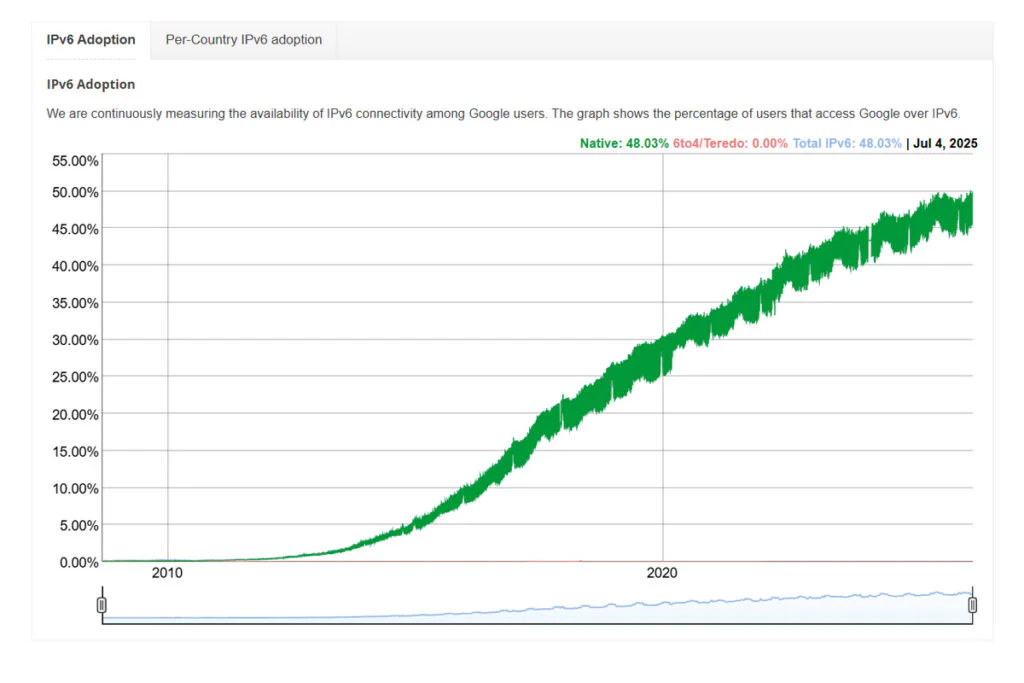
IPv6 has officially reached parity with IPv4 in Google’s global traffic mix, a milestone that comes nearly three decades after the protocol was introduced in 1998. By late March, Google recorded 50 percent of worldwide users accessing its services via IPv6. The shift underscores steady progress toward replacing IPv4, whose limited address space has struggled to keep pace with modern internet growth.
Google’s data shows global IPv6 usage has steadily increased from almost zero in early 2012 to 50.1 percent on March 28, briefly moving ahead of IPv4. While that level was not sustained, usage now generally ranges between 45 percent and 50 percent.
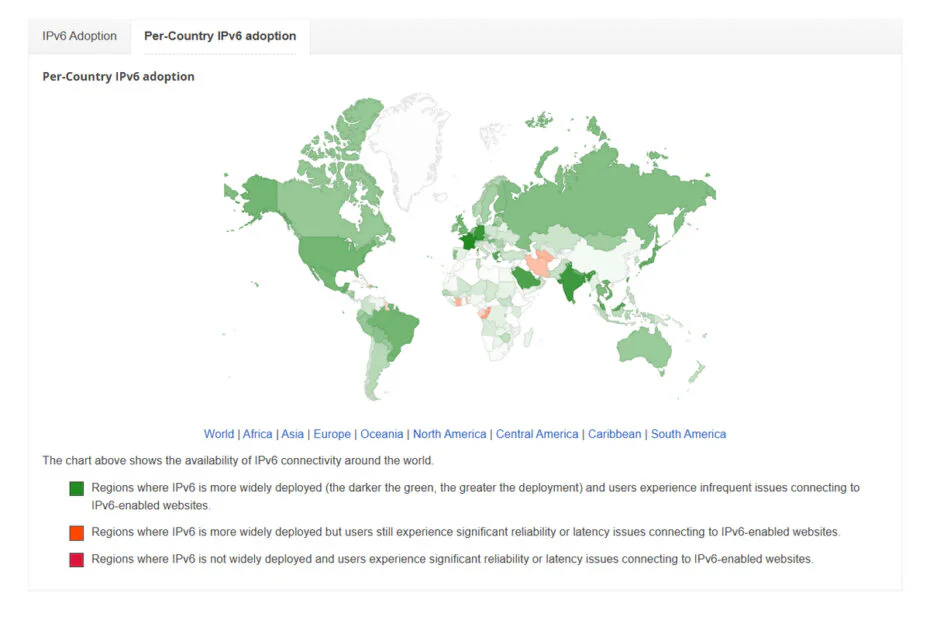
APNIC estimates that 43 percent of users now depend on IPv6, with deployment rates in Asia and the Americas approaching 50 percent. Cloudflare, using packet traffic metrics instead of address allocation data, says roughly 40 percent of internet packets now traverse IPv6 networks. Together, the numbers confirm that IPv6 has shifted from a transitional technology to mainstream infrastructure.
Introduced in 1980, the IPv4 protocol offers about 4.3 billion addresses in theory and closer to 3.7 billion in real-world use. The rapid growth of internet-connected devices, from personal computers to smartphones, and later IoT hardware and cloud systems, depleted that pool far sooner than expected.
By 2011, the global IPv4 pool managed by the Internet Assigned Numbers Authority (IANA) was effectively depleted, with regional registries reaching the same point soon after. Remaining addresses moved into a secondary market, where individual IPv4 addresses sold for around $50 in 2019, while larger address blocks became valuable enough to be used as loan collateral.
Assigning a public IPv4 address now comes with a clear cost at scale. Amazon underscored that shift in 2024 by introducing a $0.005 per hour charge for every IPv4 address assigned to its services. The fee may seem minor per address, but it grows quickly at large volumes and gives operators another incentive to move more traffic to IPv6.
From a technical standpoint, IPv6 solves the main limitation of IPv4. Introduced in 1998, it expands the address pool to 2 to the 128th power, effectively eliminating allocation limits. Even so, adoption moved slowly for years because deployment was complex and stopgap measures such as Network Address Translation allowed many devices to share a single IPv4 address.
Those workarounds may have helped extend IPv4, but they also added extra processing layers to network traffic. By restoring more direct end-to-end connections, IPv6 removes much of that added overhead. In real-world testing, the design has delivered measurable gains, with Facebook reporting IPv6 connections were about 10 to 15 percent faster, while Akamai saw roughly a 5 percent improvement in mobile page load times.
Initial objections to IPv6, including header overhead and the operational burden of running IPv6 through IPv4 tunnels, have weakened as network hardware and software stacks advanced. The primary barrier now is less about engineering and more about organizational inertia. Because IPv4 still performs adequately and NAT-based infrastructure is already established, many enterprises have deferred transition plans.
Recent figures suggest IPv6 adoption is gaining momentum as address scarcity creates measurable costs and operational inefficiencies, while large platforms increasingly treat IPv6 traffic as standard. The March 28 milestone does not end IPv4’s role, but it marks an inflection point, with IPv6 reaching a comparable share of real-world internet traffic for the first time.
Maybe you would like other interesting articles?